The 6 Best Quizlet Alternatives in 2026 (Honest Comparison)
Quizlet used to be the app you could open the night before an exam without thinking about it. Type a set, send the link, run Learn mode until it stuck. The free version no longer works that way. As of mid-2026, the free tier shows ads, cuts off Learn mode after five rounds, and stops you after a single practice test, then asks for Quizlet Plus (list price $7.99/month or $35.99 a year; promo discounts are common). Paying doesn't even remove all usage limits: the standard Plus tier caps Learn at 20 rounds and practice tests at 3 per month, and lifting the caps entirely takes Plus Unlimited at $44.99/year. Offline study and the AI tools sit behind the paywall too.
None of this makes Quizlet a bad product. Its library of pre-made sets is still the biggest, and the study modes are fast and reliable for what they do. But if you open the app to study only to get hit with a paywall on round six, you have every reason to look for alternatives. This guide compares five Quizlet alternatives in 2026, and it includes the real trade-offs for each.
Disclosure: KaChiKa (#1 below) is our app.
What to Look For in a Quizlet Alternative
Quizlet users are mostly students with a test date. The criteria are different from what a hardcore Anki user cares about:
- Free tier usability — Can you actually finish a study session without hitting a paywall? Check the usage limits before you commit.
- Time to first session — You usually pick a study app in a single evening, often a stressful one. Anything with a 100-page manual loses.
- Exam modes — Practice tests, write mode, match games. Cramming is a legitimate use case; pretending otherwise is snobbery.
- Your existing sets — Years of Quizlet sets are a real switching cost. An import tool matters.
- Spaced repetition quality — A real algorithm (SM-2 or FSRS family) beats a homegrown "mastery" meter for anything you need to remember past Friday. Here's how the algorithms differ.
- Sharing — Study sets are social. Can a classmate use what you made?
The Comparison Table
| App | Card creation | Free? | SRS | Best for |
|---|---|---|---|---|
| KaChiKa | AI photo (5 sec) | Free tier + Pro | FSRS | Language vocab from daily life |
| Knowt | Manual / AI from notes & PDFs | Generous free, paid AI tiers | Custom | 1:1 Quizlet replacement, classes |
| Turbo AI / Gizmo | AI from docs, PDFs, videos | Freemium limits | Adaptive / Quiz | Lecture & doc summaries for exams |
| Anki | Manual (slow) | Desktop free / $25 iOS | SM-2 + FSRS | Power users, huge shared decks |
| Brainscape | Manual / AI (Pro) | Limited free + Pro | Confidence-based | Structured exam prep |
| Memrise | Pre-made courses | Free tier, Pro for offline & AI | Custom | Beginner language courses |
1. KaChiKa — Best If Your Quizlet Sets Are Language Vocabulary
Half of Quizlet is vocabulary sets — Spanish unit 4, JLPT N5, IELTS word lists. If that's what you use it for, the paywall isn't even the biggest issue. The root problem is that someone still has to type every card, and abstract word lists are the least memorable format for vocabulary anyway.
KaChiKa skips the typing. Point your phone at whatever is in front of you — your desk, a menu, a train platform — and in about 5 seconds it turns the scene into flashcards, complete with target-language vocabulary, natural example sentences, and audio pronunciation. The review engine is FSRS spaced repetition, the same science behind modern Anki, so the cards come back right before you'd forget them.
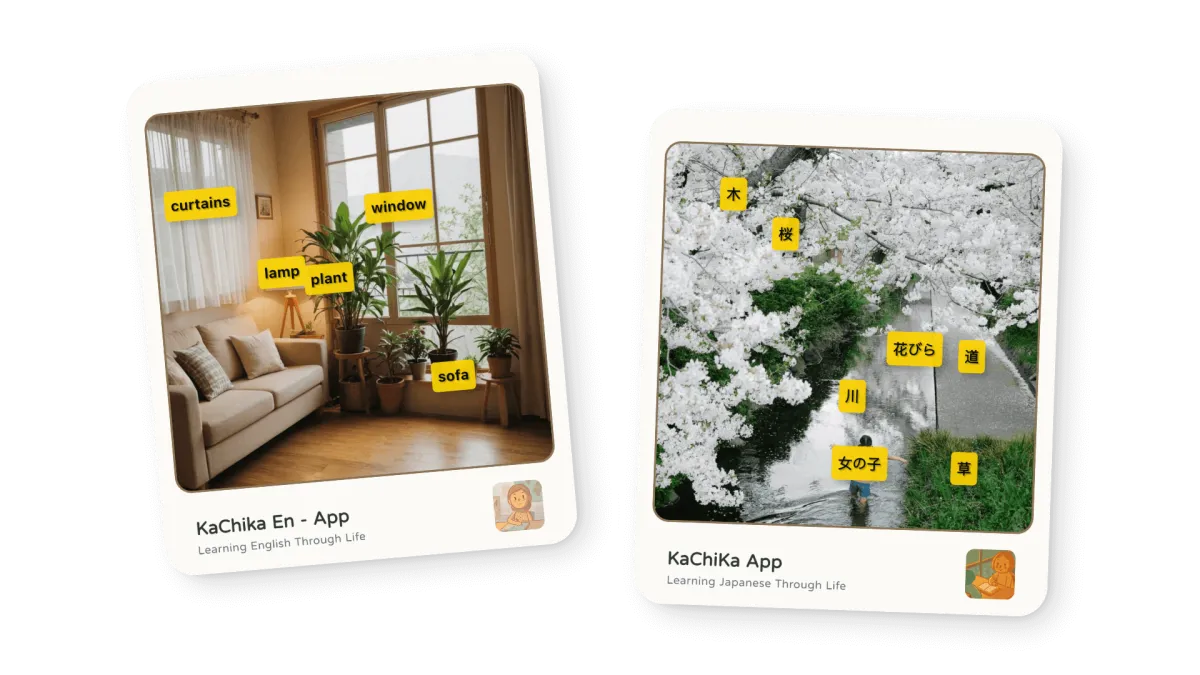
KaChiKa's main advantage is speed: a photo becomes cards in seconds, with the scene attached so the word has context instead of being buried on row 47 of a spreadsheet. It uses FSRS scheduling rather than a generic mastery meter, and covers English, Korean, French, Chinese, Spanish, and Italian in the main app, with a dedicated Japanese (JLPT) edition. The free tier lets you start on iOS or Android, though heavy daily AI use will push you toward Pro.
It is not aimed at classroom subjects — you can't study someone's AP Bio set on it — and there is no public set library or multiple-choice test simulator like Quizlet's Test mode.
Best for: Anyone whose Quizlet habit was really a language habit: students, travelers, immigrants, JLPT/IELTS preppers.
Get it: Download KaChiKa free
2. Knowt — The Closest Free Replacement for the Quizlet You Remember
If you want the 2019 Quizlet experience back, Knowt is the closest match. Its free plan gives you unlimited flashcards, Learn-style modes, and practice tests — the features Quizlet now limits. It also generates flashcards with AI from your notes, PDFs, and lecture slides.
The killer feature for switchers: paste a Quizlet set URL (or a username) and Knowt imports the whole thing in a few clicks. Your years of study sets aren't held hostage.
Pros:
- Free tier covers what Quizlet's paywall took: unlimited Learn-style rounds and practice tests
- One-click Quizlet import — the switching cost is nearly zero
- AI flashcard generation from notes, PDFs, and lectures on the free plan
- Familiar, student-friendly interface; teachers and classes are supported
Cons:
- Public library is much smaller than Quizlet's — finding pre-made sets for an obscure course is harder
- The top AI tier (Ultra) runs $149.99/year, more than Quizlet Plus Unlimited
- Study modes mirror Quizlet's design rather than a proven SRS algorithm — fine for Friday's test, weaker for year-long retention
- A younger company than Quizlet; the free-forever economics depend on upsells
Best for: Students who liked Quizlet's workflow and simply want the paywalls and usage limits removed, especially for school subjects like biology, history, and law.
3. The New AI Document Makers: Turbo AI, Gizmo & Astra AI
Beyond Knowt, 2026 has seen a breakout wave of AI-native study tools like Turbo AI, Gizmo, and Astra AI. Instead of typing cards or scanning individual flashcards, these apps ingest entire PDF textbooks, lecture audio recordings, or YouTube videos to automatically generate multiple-choice quizzes and summaries.
Pros:
- Ingests massive textbooks and lecture slides in seconds
- Great for broad academic exam review (AP Bio, College Chemistry)
- Generates varied question types (cloze, multiple-choice, true/false)
Cons:
- Tightly metered free tiers with aggressive subscription paywalls for continuous AI uploads
- Generates text summaries rather than sticky visual memory anchors
- Lacks specialized spaced repetition for long-term vocabulary acquisition
Best for: College students who need to turn a 50-slide lecture presentation into an instant practice quiz the night before an exam.
4. Anki — The Power Move (Free Forever, but You Pay in Time)
Anki is the opposite trade from Quizlet: the software asks nothing of your wallet on desktop and Android ($25 one-time on iOS) and everything of your patience. In exchange you get FSRS (since v23), the scheduling that has held up for serious long-term users, plus a huge library of shared decks for MCAT, JLPT and everything in between, and full control over your data.
Pros:
- Free on desktop and Android, no usage meters, ever
- FSRS scheduling beats any custom "mastery" system for long-term retention
- Massive shared deck library; add-ons for cloze, image occlusion, TTS
- Your data is yours — export everything, self-host sync if you want
Cons:
- Card creation is manual and slow; the UI looks like 2010
- Real learning curve — most Quizlet users bounce off it in a week
- No class features, no polished test mode, nothing social
- The $25 iOS app often catches users off guard if they expect a completely free tool
Best for: Self-directed learners with a long horizon — med students, language autodidacts, anyone studying for years rather than Fridays. If that's you, read our full Anki alternatives breakdown, which is written for exactly that audience.
5. Brainscape — Confidence-Based Cramming With Structure
Brainscape's whole pitch is one mechanic: after each card you rate your confidence 1–5, and the algorithm reschedules accordingly. It's simpler than FSRS but honest about what studying feels like, and the web and mobile apps are clean and consistent across devices. The catalog of "certified classes" (AP subjects, MCAT, bar prep, languages) is curated rather than user-dumped, which means higher average quality than Quizlet's public sets.
Pros:
- Confidence-based repetition is intuitive — no settings to misconfigure
- Curated, professionally made certified decks for major exams
- Clean cross-platform experience; good progress stats
Cons:
- Subscription-heavy: the free tier is limited, and much of the catalog needs Pro
- Pro is $19.99 a month, or $7.99 a month when billed annually, with a $199.99 lifetime option available
- AI flashcard generation is locked to Pro
- Less flexible than Anki, less free than Knowt — it sits in an awkward middle
Best for: Exam preppers who want pre-made, quality-controlled decks and will pay for structure.
6. Memrise — If "Quizlet" Meant "Language Course" to You
Memrise isn't a flashcard tool anymore; it's a guided language course app with native-speaker video clips and, since 2025, a set of AI "buddies" for grammar help and speaking practice. The free tier covers the core courses and spaced review. Pro adds offline lessons, unlimited AI conversation, and removes ads — pricing varies by region, but the annual plan lands around $60/year.
Pros:
- Native-speaker video for real pronunciation and listening
- AI conversation practice is a feature Quizlet never had
- Low-effort onboarding — pick a language, start in a minute
Cons:
- You can't study your own content — no custom sets means no exam prep
- Spaced repetition is shallower than FSRS-based apps
- Useful as a supplement, not a complete system; vocabulary breadth over depth
Best for: Absolute beginners starting a new language who want a course, not a card box. If you're weighing course-led apps against self-directed review, our Duolingo vs Anki comparison covers that exact trade-off.
How to Choose
Three questions sort almost everyone:
1. What's actually in your Quizlet sets?
- Language vocabulary → KaChiKa
- School subjects (bio, history, psych) → Knowt
- Professional exams with curated decks → Brainscape or Anki
2. Do you study with a class or alone?
- With a class, sharing sets → Knowt
- Alone, from your own life → KaChiKa or Anki
3. Is the goal Friday's test or next year's fluency?
- Friday → Knowt or Brainscape (cram modes, practice tests)
- Next year → an FSRS app: KaChiKa or Anki
The Verdict
There's no single Quizlet replacement, because Quizlet was really two distinct products wrapped in a single interface. As a classroom study tool, Knowt is the honest free successor — same workflow, an import tool, no meter at round five. For vocabulary, KaChiKa changes more than the billing model. You point the camera at something in front of you and get contextual cards with example sentences and FSRS scheduling behind them. The typing step disappears.
Plenty of switchers end up using both: Knowt for academic coursework, and KaChiKa for the language they actively use in daily life.
Try KaChiKa on iOS or Android. Start with a photo, review offline, no round limits on the free tier.
Our pick for language learners: Download KaChiKa free, then see how photo-based flashcards compare to Anki.
FAQ
What are Quizlet's free version limits in 2026?
As of mid-2026, Quizlet's free tier shows ads and cuts off Learn mode after five rounds and one practice test, with offline study and AI tools locked behind Quizlet Plus ($7.99/month or $35.99/year). Even standard Plus meters usage at 20 Learn rounds and 3 practice tests per month; removing all caps requires Plus Unlimited at $44.99/year.
What is the best free Quizlet alternative?
Knowt is the closest one-to-one replacement: its free plan includes unlimited flashcards, Learn-style study modes, practice tests, and a tool that imports existing Quizlet sets from a URL. For language vocabulary specifically, KaChiKa (free tier + Pro) is the bigger upgrade — it generates flashcards from photos with FSRS spaced repetition, so you never type a set at all.
Is Knowt better than Quizlet?
Knowt gives away most of what Quizlet now charges for — unlimited Learn-style rounds, practice tests, and AI flashcard generation from notes — and it imports Quizlet sets in a few clicks. Quizlet still wins on its public set library, the largest anywhere, and on overall polish. If you depend on finding pre-made sets for any course, Quizlet keeps that edge; if you make your own sets, Knowt removes the paywall pain.
Can I move my Quizlet sets to another app?
Yes. Knowt has a built-in import tool: paste a Quizlet set URL or username and it copies the flashcards over in a few clicks. KaChiKa takes a different approach — instead of importing typed sets, it creates new vocabulary cards from your photos with AI, which suits language learners better than classroom subjects.
Which Quizlet alternative is best for language learning?
KaChiKa, if you want vocabulary from your real life: it turns photos into flashcards with example sentences, pronunciation, and FSRS spaced repetition, and it's free to start on iOS and Android (heavy daily AI generation needs the Pro tier). Memrise suits absolute beginners who prefer a guided course with native-speaker video over making their own cards.
