JLPT N4 Vocabulary List: How Many Words and the Smartest Way to Learn Them
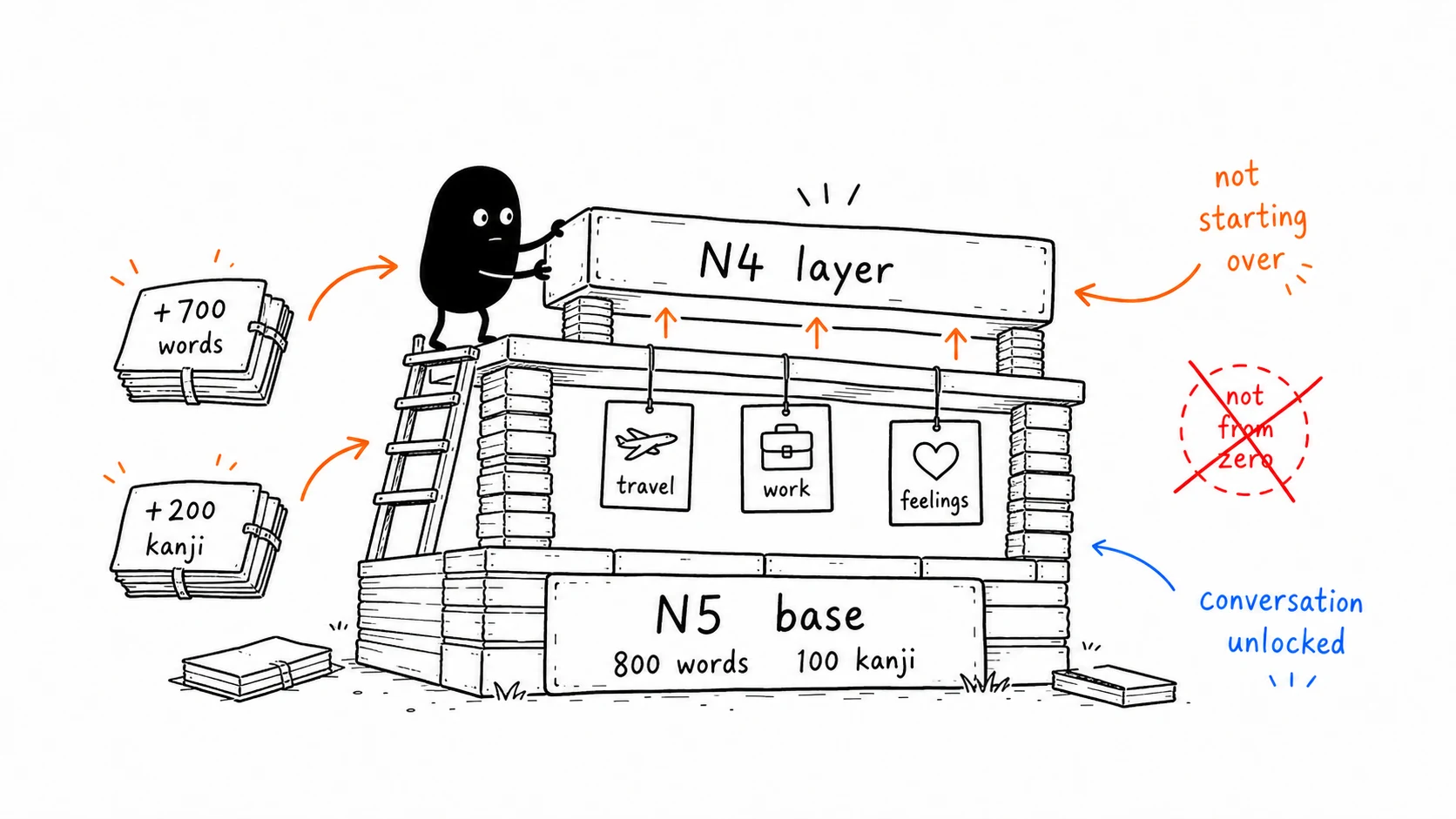
TL;DR: JLPT N4 covers roughly 1,500 vocabulary words in total — about 700 new words on top of the ~800 you already know from N5 — plus about 300 kanji. The N5 method still works for concrete words: tie each one to an image and review on a spaced-repetition schedule. The new challenge at N4 is that more words are verbs, adjectives, and abstract concepts you can't photograph directly. The fix is to anchor those to a short scene or sentence instead of a single object.
How many words do you actually need for N4?
The JLPT does not publish an official word list, but the community consensus is consistent and cumulative — each level includes everything below it:
| Level | Vocabulary (total) | Kanji (total) | New words vs. previous | What it unlocks |
|---|---|---|---|---|
| N5 | 800 | 100 | — | Basic phrases, self-introduction |
| N4 | 1,500 | 300 | ~700 | Everyday conversation, simple reading |
| N3 | 3,000 | 650 | ~1,500 | Bridge level — news headlines, daily topics |
So the N4 vocabulary lift is real but bounded: roughly 700 new words and 200 new kanji. If you passed N5, you are not starting over — you are extending a base you already have. (New to this? Start with the JLPT N5 vocabulary guide first.)
What actually changes from N5 to N4
This is the part most word lists ignore. At N5, the vast majority of vocabulary is concrete nouns — food, places, body parts, nature. Those are easy: a single photo teaches them. N4 shifts the balance:
- Verbs multiply — to decide (kimeru), to prepare (junbi suru), to make it on time (maniau), to look for (sagasu). You can't photograph "to decide," but you can picture the moment of deciding.
- Adjectives and adverbs get abstract — complicated (fukuzatsu), safe (anzen), suddenly (kyuu ni), almost (hotondo).
- Relationship and reason words appear — words about time, cause, comparison, and intention.
Verbs are where this bites first. If you want them with a sentence attached rather than as a bare list, 100 essential Japanese verbs covers 24 N4 verbs — sagasu among them, plus 考える, 続ける and 集める — each in dictionary form with one everyday sentence and its kana reading.
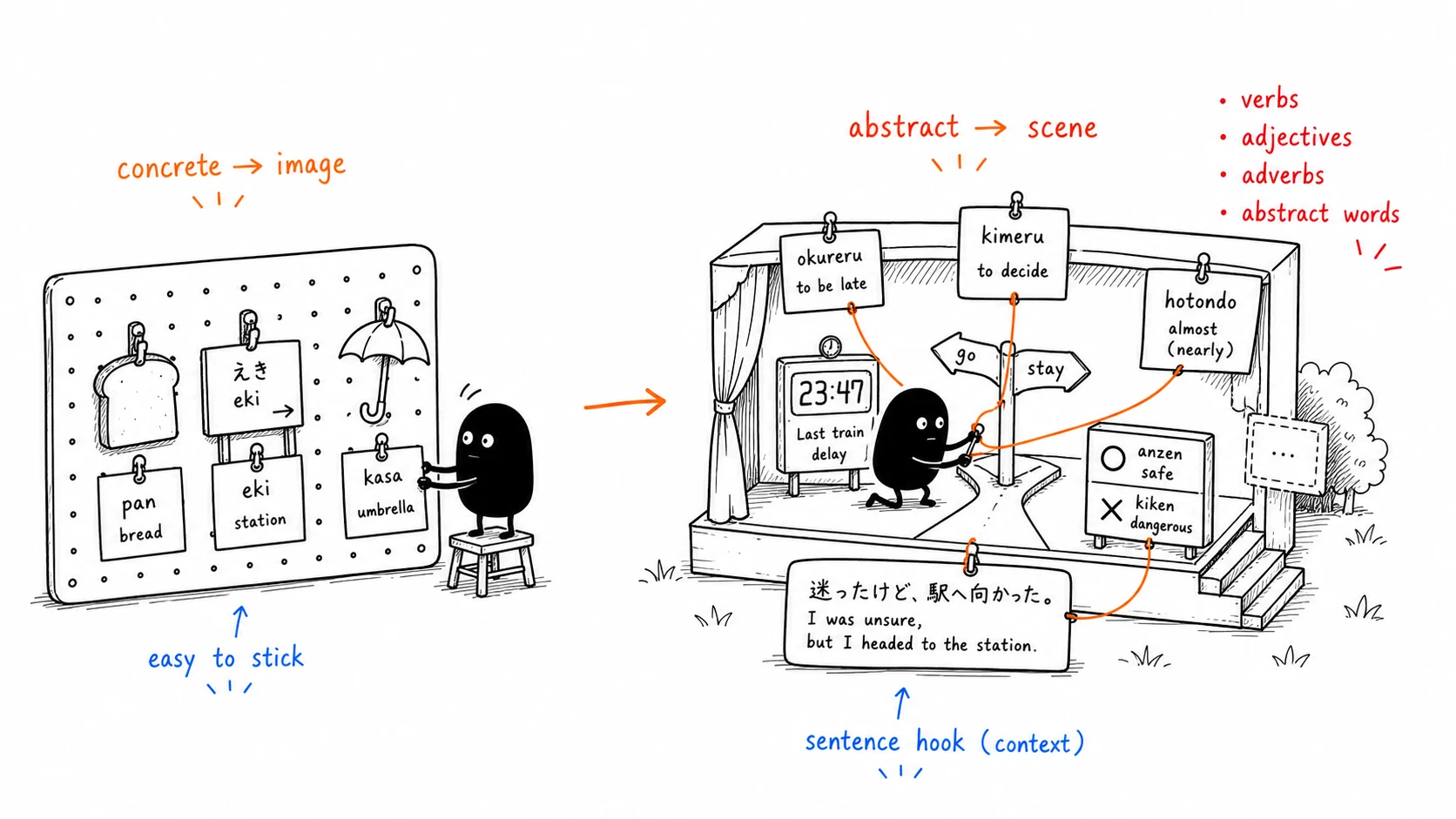
The lesson: keep the N5 method for concrete words, and make one simple adjustment for the rest. Concrete words → image. Abstract words → a short scene or example sentence. Both feed into the same spaced-repetition schedule.
Why rote memorization fails (and what beats it)
If you have ever written a word twenty times and forgotten it the next morning, the problem isn't you — it's the method. Two well-documented effects explain why:
- The Picture Superiority Effect — people remember images far better than isolated words. A word tied to a vivid image or scene is simply stickier than a word on a list.
- The Ebbinghaus forgetting curve (1885) — without review you lose most new information within days. The fix isn't more review, it's timed review: see the word again right before you'd forget it. For the science behind the schedule, see SM-2 vs FSRS: how spaced repetition algorithms work.
At N4, where more words are abstract, context does the heavy lifting that a single image did at N5. A word learned inside a real sentence carries its grammar and usage with it — which matters more as N4 reading gets harder.
N4 vocabulary by category
| Category | Examples (romaji) | How to learn it |
|---|---|---|
| Everyday verbs | kimeru, sagasu, maniau, tsutaeru | Picture the action; pair with a sentence |
| Daily-life nouns | yakusoku, riyuu, kikai, jikan | Many still picturable — a calendar, a ticket |
| Adjectives | fukuzatsu, anzen, taisetsu, hen | Anchor to a contrasting pair (safe ↔ dangerous) |
| Common adverbs | hotondo, kyuu ni, zuibun, kitto | Learn inside example sentences |
| Travel & society | yoyaku, uketsuke, annai, kaigi | Photograph real signs and situations |
Notice the split: the noun and travel categories are still photographable — a station sign, a reservation screen, a meeting room. The verb, adjective, and adverb categories need a sentence or scene. A photo of your train being late teaches okureru far better than the word alone.
A realistic 8–10 week N4 study plan
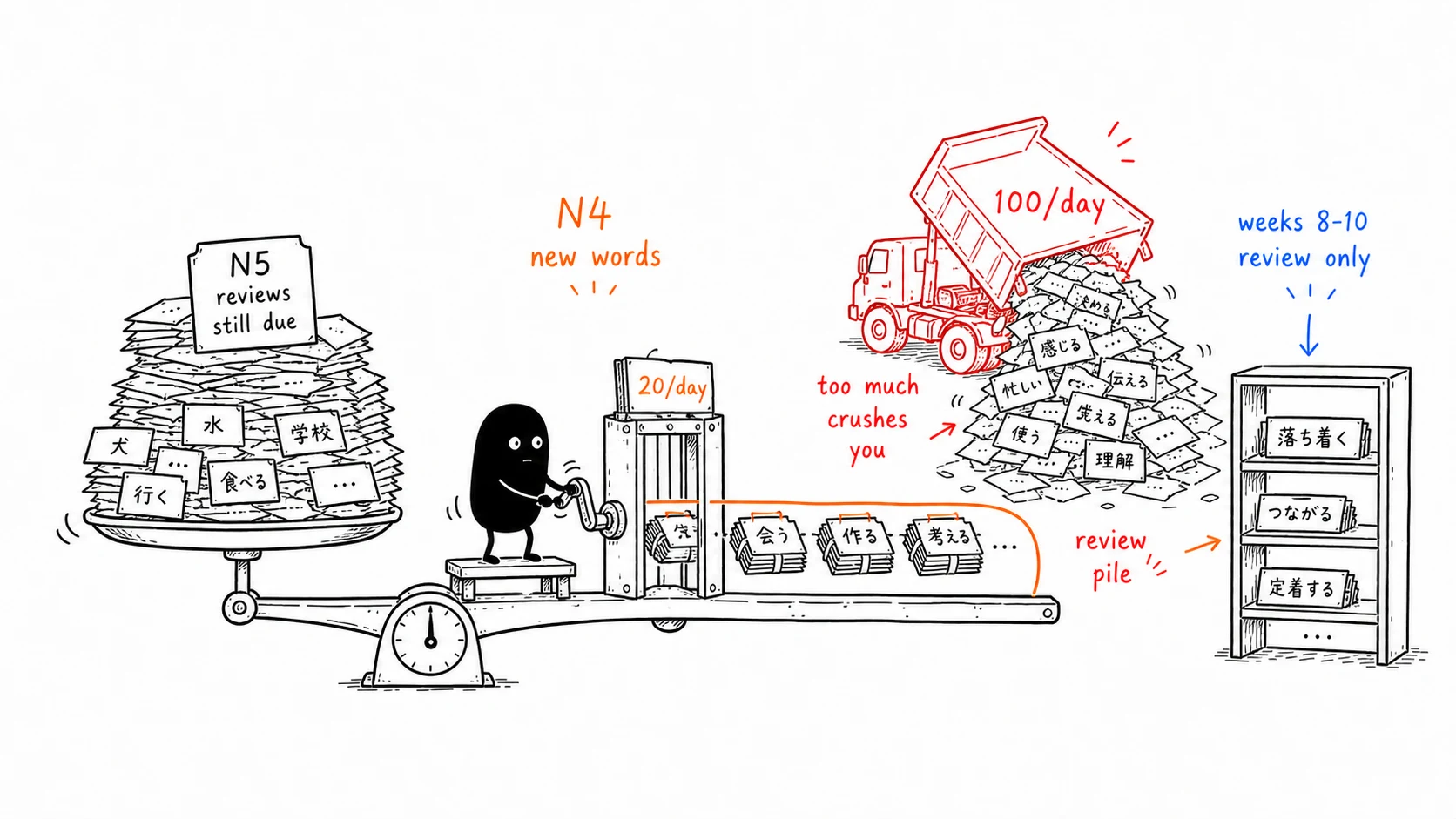
The real difference at N4 is the review load, not the raw word count: every new word stacks on top of the ~800 N5 words you're already maintaining. Pace yourself for that accumulating load, not for setting daily records:
- Weeks 1–7: ~20 new words per day, grouped by theme (travel, feelings, work) rather than alphabetically. ~140 words/week gets you through the ~700 new words.
- Daily: 10–15 minutes of spaced-repetition review on whatever is due. This is the part that actually moves words into long-term memory — budget slightly more time than at N5 because the review pile is larger.
- Weeks 8–10: stop adding new words. Review only, plus N4 grammar, the ~300 kanji, and N4-level listening (slow podcasts, drama clips).
The N4 trap isn't speed, it's polish: don't hand-craft a flawless card for every abstract word. Grab the sentence where the word appeared and move on — a card that preserves its context, reviewed consistently, teaches real-world usage that an isolated word pair never will.
Turning the plan into something you'll actually do
This is where a photo-to-card tool earns its keep — and where N4 rewards it more than N5. Point your camera at a real scene (a station sign, a restaurant menu, a meeting agenda) and the vocabulary in the shot becomes ready-made cards, already in a spaced-repetition queue. For abstract words, snap the situation that triggers them — the word arrives wrapped in context, which is exactly what N4 demands.
If you're coming from Anki, the trade-off is familiar: see how KaChiKa compares to Anki for the manual-deck vs. photo-card difference. And for the kanji side of N4, the same visual approach applies — N5 kanji mnemonics shows the method that scales to N4's ~300 characters.
Start your N4 list today: snap a photo of what's around you and turn it into flashcards — download KaChiKa free.
FAQ
How many vocabulary words do I need for JLPT N4?
Around 1,500 words total and about 300 kanji. Since N5 already covers ~800 words and ~100 kanji, N4 adds roughly 700 new words and 200 new kanji. There is no official JLPT word list, but these figures reflect the widely accepted consensus.
How is N4 vocabulary harder than N5?
N5 is mostly concrete nouns you can photograph — food, places, objects. N4 shifts toward verbs, adjectives, adverbs and more abstract words (feelings, time relationships, reasons). These are harder to picture directly, so the smartest approach pairs each word with an example sentence or a small scene rather than a single object.
What is the fastest way to memorize JLPT N4 vocabulary?
Keep the N5 method for concrete words — attach each one to a real image and review on a spaced-repetition schedule. For N4's abstract and verb-heavy vocabulary, anchor the word to a mini-scene or specific scenario (a photo of the action, or a sentence from your own life) so it carries context. Timed review right before you forget is what moves words into long-term memory.
How long does it take to go from N5 to N4?
At a sustainable pace of about 20 new words a day plus 10–15 minutes of daily review, most learners cover the ~700 new N4 words in roughly 8 to 10 weeks. The extra time required compared to N5 comes from the heavier grammar and the harder-to-picture vocabulary, not from a much longer word list.
