The Leitner System: How the Flashcard Box Method Works (and Its Modern Upgrade)
TL;DR: The Leitner system is a box method for flashcards: every card starts in Box 1, a correct answer promotes it to a box you review less often, and a wrong answer sends it back to Box 1. It's the simplest working form of spaced repetition, concentrating your effort on what you haven't mastered yet. It's free and tactile, but the intervals are fixed and it doesn't scale, which is exactly what modern algorithms like SM-2 and FSRS were built to fix.
How the box method works
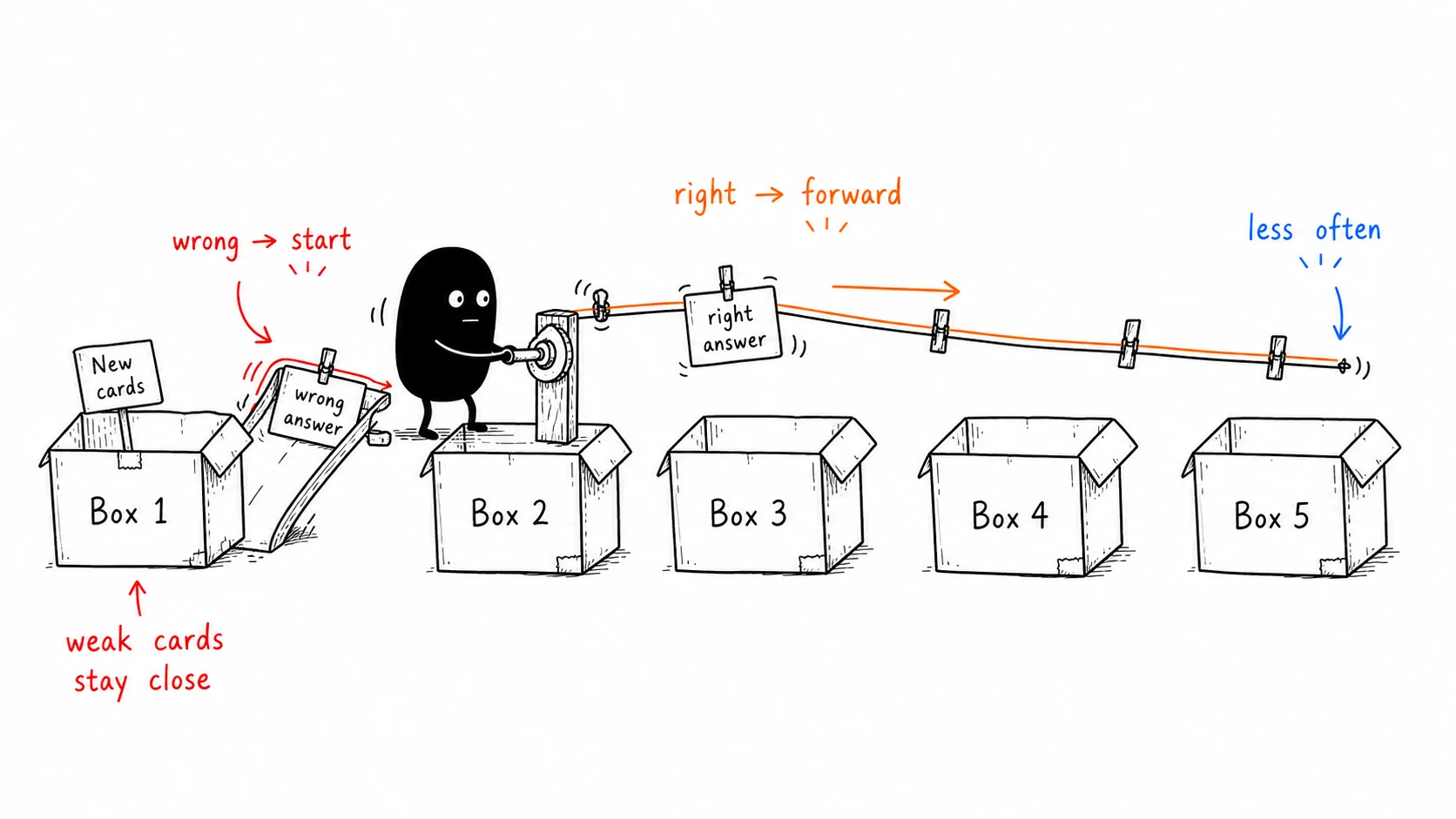
Picture a row of numbered boxes. The rule is one sentence: cards you get right move forward; cards you get wrong go back to the start.
- Every new card goes into Box 1.
- You review a box on its schedule. Answer a card correctly → it moves up one box.
- Miss a card → it drops back to Box 1, no matter where it was.
- Higher-numbered boxes are reviewed less often, so well-known cards resurface rarely while difficult cards stay in your daily rotation.
That's the entire mechanism. The effect: your effort concentrates on the material you haven't mastered, instead of spreading evenly across everything you already know.
The intervals: a simple 5-box schedule
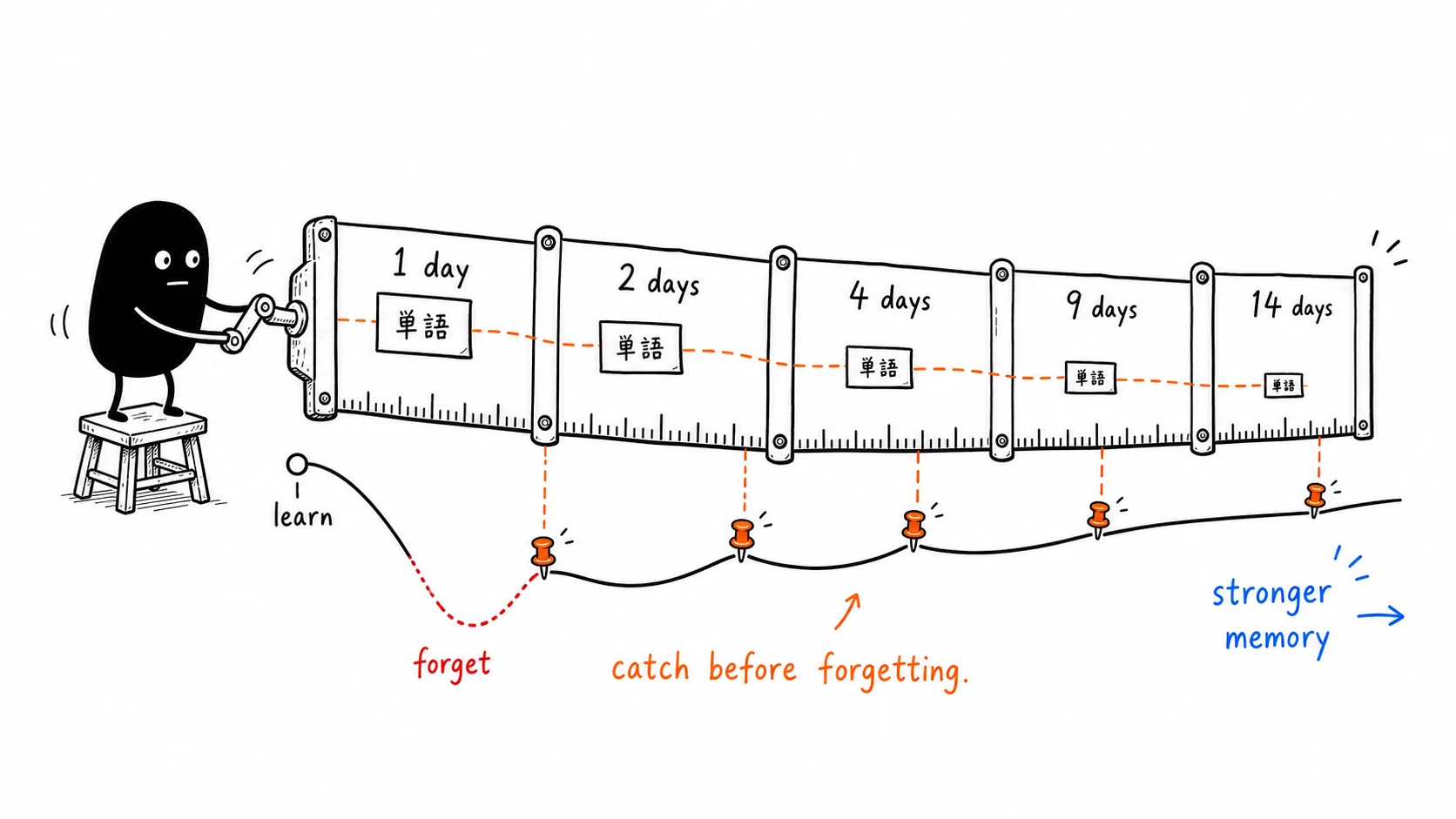
Each box up roughly doubles the gap between reviews. A widely used setup:
| Box | Review every | Meaning |
|---|---|---|
| Box 1 | 1 day | New or recently-missed cards |
| Box 2 | 2 days | Starting to stick |
| Box 3 | 4 days | Fairly solid |
| Box 4 | 9 days | Well learned |
| Box 5 | 14 days | Nearly permanent — graduate it |
The specific numbers aren't sacred. What matters is the expanding gap: it tracks the Ebbinghaus forgetting curve — you see each card again right before you forget it, and every successful recall flattens the curve further.
Why it works (the science underneath)
The Leitner system is spaced repetition in physical form, and spaced repetition is one of the most robustly supported findings in learning research. Two effects do the work:
- The spacing effect — information reviewed at increasing intervals is retained far longer than the same time spent cramming in one sitting.
- Active recall — the box method forces you to retrieve the answer before flipping the card, and retrieval practice builds stronger memory than re-reading. For the full picture, see how to learn vocabulary faster.
Where the physical box method falls short
For a few dozen cards, a real shoebox of index cards is genuinely great. The cracks show as you scale:
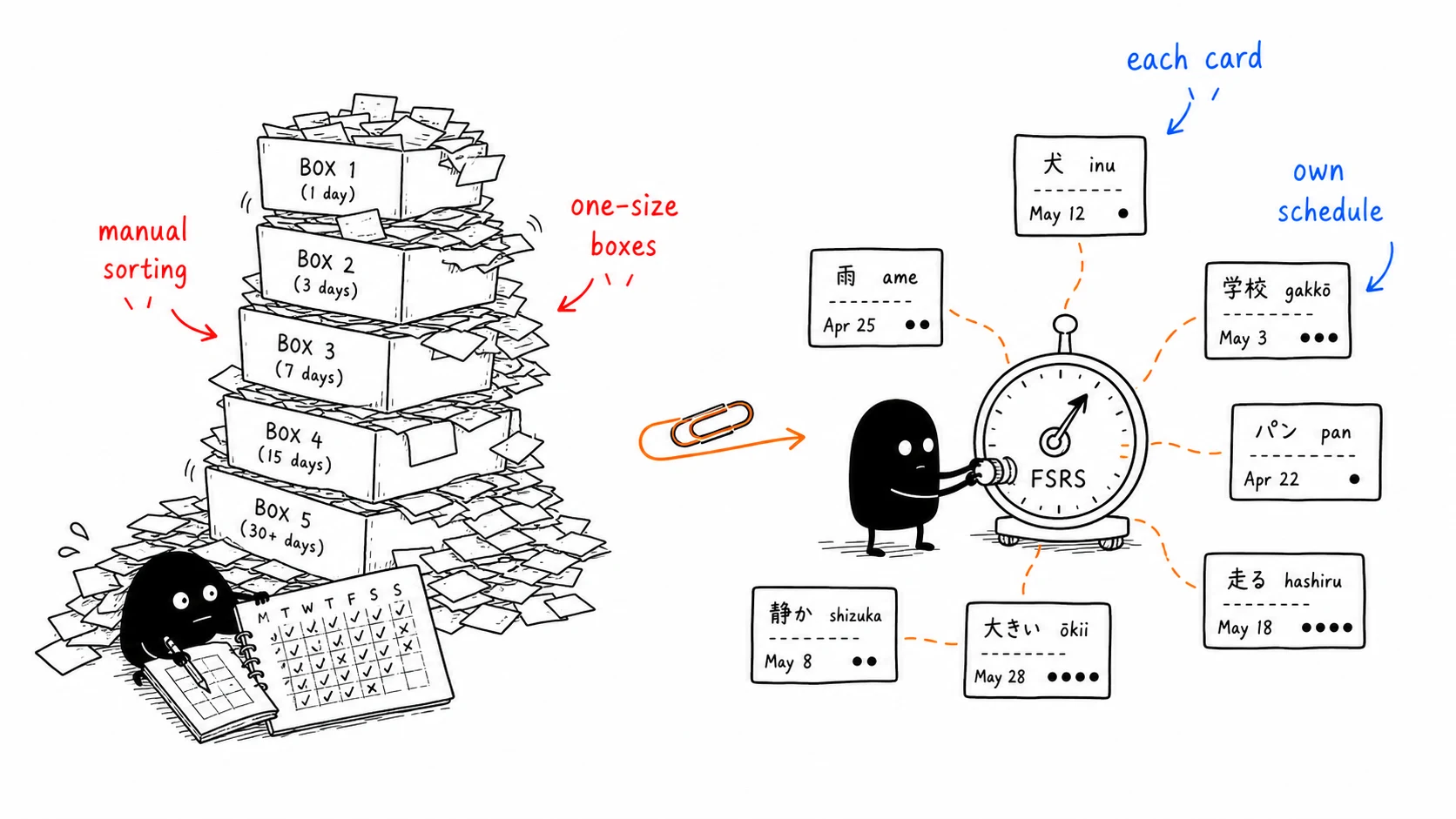
- Fixed, one-size-fits-all intervals — every card in Box 3 is treated identically, even though one is easy for you and another is barely hanging on. The system can't tell them apart.
- Manual bookkeeping — you sort cards and track which box is due when. Miss a day and the schedule drifts.
- Doesn't scale — a few hundred cards becomes a physical sorting chore; a few thousand is unmanageable.
- No adaptive difficulty tracking — it doesn't adapt to how difficult each specific card is for you over time.
The modern upgrade: per-card scheduling
This is exactly the problem computer spaced-repetition algorithms solve. Instead of five shared boxes, each card gets its own schedule based on how hard you found it. The SM-2 algorithm assigns every card an individual ease factor; FSRS goes further, modeling your personal memory to predict the optimal moment for each card. See SM-2 vs FSRS: how spaced repetition algorithms work for the difference.
In other words: the Leitner system is the idea, and modern apps are the automated version — the boxes, the dates, and the difficulty tracking all handled for you. KaChiKa runs this kind of per-card scheduling automatically, and pairs it with photo-to-card creation so building the deck is as fast as reviewing it. (Coming from index cards or Anki? See KaChiKa vs Anki.)
Skip the shoeboxes: let the algorithm sort your cards for you — download KaChiKa free.
FAQ
How does the Leitner system work?
You sort flashcards into numbered boxes. Every new card starts in Box 1. When you answer a card correctly, it moves up one box; when you get it wrong, it goes back to Box 1. Higher-numbered boxes are reviewed less often, so the cards you know well resurface rarely while the ones you struggle with come back daily. It's a simple, physical form of spaced repetition.
What are good Leitner box intervals?
A common 5-box schedule reviews Box 1 every day, Box 2 every 2 days, Box 3 every 4 days, Box 4 every 9 days, and Box 5 every 14 days. The exact numbers matter less than the principle — each successive box roughly doubles the review interval, so review effort concentrates on what you haven't learned yet.
Who invented the Leitner system?
German science journalist Sebastian Leitner popularized it in his 1972 book on how to learn. It predates computer spaced-repetition software and is the conceptual ancestor of modern algorithms like SM-2 and FSRS.
What are the limits of the Leitner system?
Intervals are fixed and identical for every card, so an easy card and a barely-remembered one in the same box get treated identically. It's manual — you sort physical cards and track dates yourself — and it doesn't scale past a few hundred cards. Modern spaced-repetition algorithms fix this by scheduling each card individually based on your individual recall performance.
