Spaced Repetition Algorithms: SM-2 vs FSRS (and How to Actually Use Them)
If you've ever crammed for an exam, you know the feeling. You memorize everything the night before, pass the test, and a week later ninety percent of it is gone. That's not a willpower problem. It's the forgetting curve doing exactly what it always does, and most flashcard study walks straight into it. A spaced repetition algorithm is the fix, and the two that matter today are SM-2 and FSRS.
SRS vs SM-2 vs FSRS: three terms, one relationship
SRS is the category; SM-2 and FSRS are algorithms inside it. A Spaced Repetition System (SRS) is any app that schedules flashcard reviews along the forgetting curve — Anki, SuperMemo, and KaChiKa are all SRS apps. SM-2 and FSRS are the two best-known algorithms an SRS can use to decide when each card comes back: SM-2 is the 1987 SuperMemo formula Anki ran on for most of its history; FSRS is its modern, data-driven successor. One detail worth being precise about, because it's widely misreported: Anki has FSRS built in, but it is not enabled by default — you switch it on with one toggle at the bottom of deck options.
SM-2 vs FSRS at a glance
| SM-2 | FSRS | |
|---|---|---|
| Core model | Multiplies intervals using a per-card ease factor | Estimates difficulty, stability, and current retrievability |
| Personalization | Per-card ease plus manual scheduler settings | Can fit parameters to your review history |
| Review timing | Heuristic intervals | Targets a chosen probability of recall |
| Review load | Reliable, but often schedules more reviews | Roughly 20–30% fewer reviews at the same retention in large-scale benchmarks |
| Best choice in 2026 | Simple or legacy setups | Most learners choosing a modern scheduler |
The practical answer is straightforward: use FSRS when your app supports it, unless you need SM-2 for an existing workflow or older client. The rest of this guide explains why that recommendation follows from the forgetting curve, how both algorithms calculate intervals, and how to use either one without creating an impossible review backlog.
The forgetting curve, and why your brain leaks
Back in 1885 the psychologist Hermann Ebbinghaus ran experiments on himself to measure how fast memory decays. The numbers are blunt:
- 20 minutes later: about 42% forgotten
- 1 hour later: about 56% forgotten
- 1 day later: about 66% forgotten
If you learn 50 new words today, roughly 17 will survive until tomorrow (the full Ebbinghaus data, explained). The decay is steepest at the very start and flattens out over time. The useful part of his finding is the flip side: every time you successfully recall something, the next drop-off gets slower. The curve gets shallower with each review.
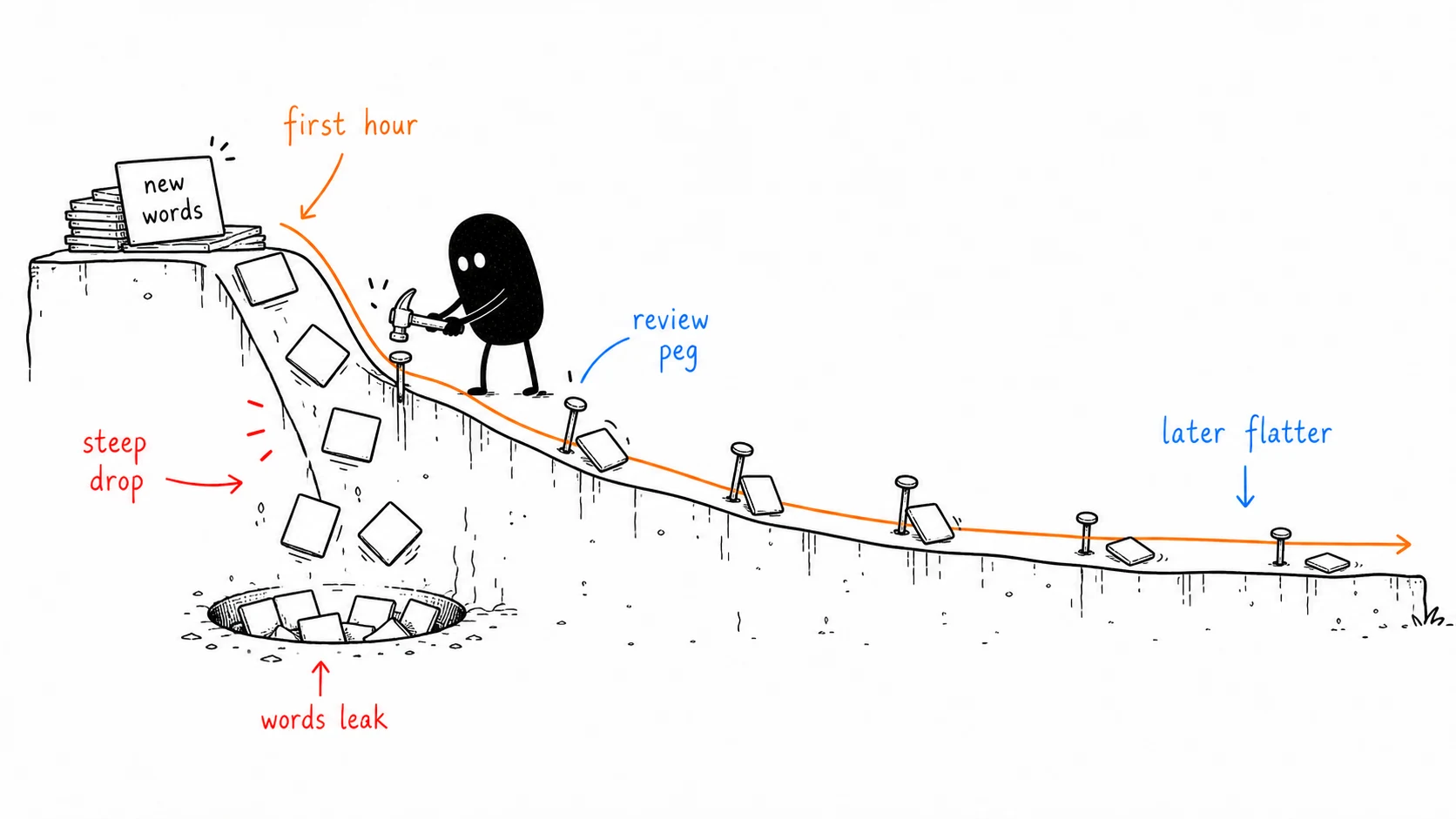
That single fact is the whole basis for spaced repetition.
Why you need an SRS at all
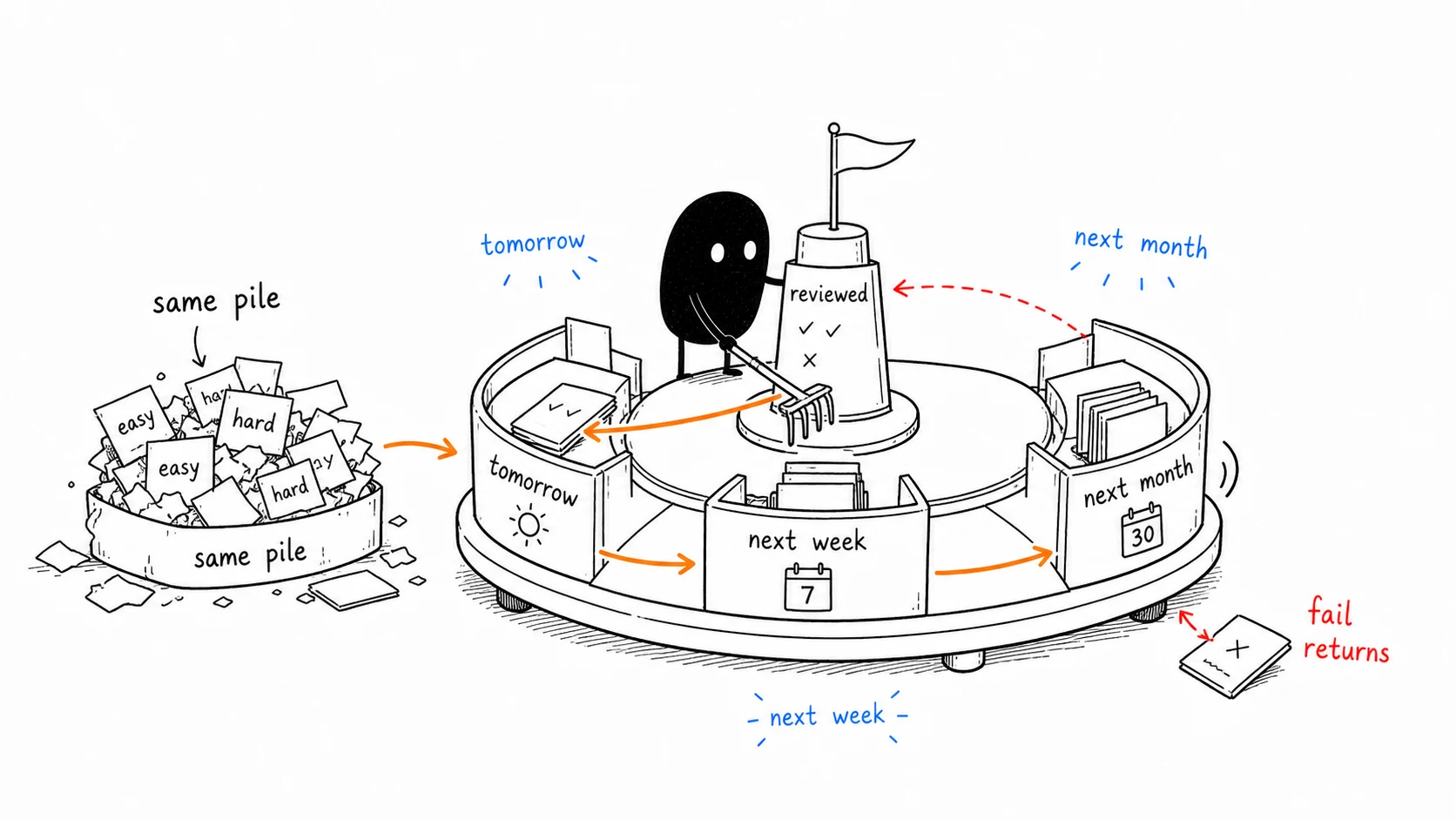
A Spaced Repetition System (SRS) attacks the forgetting curve directly. The rule is simple: the gap between reviews of one card should grow each time you recall it correctly, and reset if you fail. Get a word right, and you won't see it again for days, then weeks, then months. Miss it, and it comes back tomorrow.
Compare that to a paper deck. With physical flashcards you review every card at the same frequency, or sort them into rough "know" and "don't know" piles by hand. Both waste time: you over-study the easy words and under-study the hard ones right when you're about to lose them.
The payoff is measurable. Study 100 words without spacing and roughly 20 survive a month later; with a proper SRS schedule, 80+ survive. Your daily workload doesn't go up. SRS doesn't make you learn faster; it makes you forget more slowly.
The catch: you can't run this schedule by hand. Tracking the next due date for 300 cards on paper is hopeless. That's the job an algorithm does, and that's where SM-2 and FSRS come in.
👉 Want to see what a spaced schedule looks like on actual dates? The free Ebbinghaus review schedule generator turns a start date into a day-by-day review plan on fixed intervals, exportable to your calendar — a hands-on preview of what the algorithms below automate per card.
How SM-2 works
SM-2 is the classic. Piotr Woźniak built it for SuperMemo back in 1987, which makes it close to 40 years old, and it's still everywhere because it's simple and it works well enough. Anki ran on SM-2 for most of its life.
The mechanics, stripped down:
- After each review you rate how it went, usually on a scale like Again / Hard / Good / Easy.
- Every card carries an ease factor, a multiplier that starts around 2.5.
- A correct answer multiplies the current interval by that ease factor. For example, a card with a 10-day interval jumps to roughly 25 days, then ~60 days, and so on.
- An incorrect answer resets the card's interval back to day one and nudges its ease down, so a chronically hard card shows up more often.
That's basically it. One number per card, intervals that snowball as long as you keep getting it right, and it runs anywhere on almost no data.
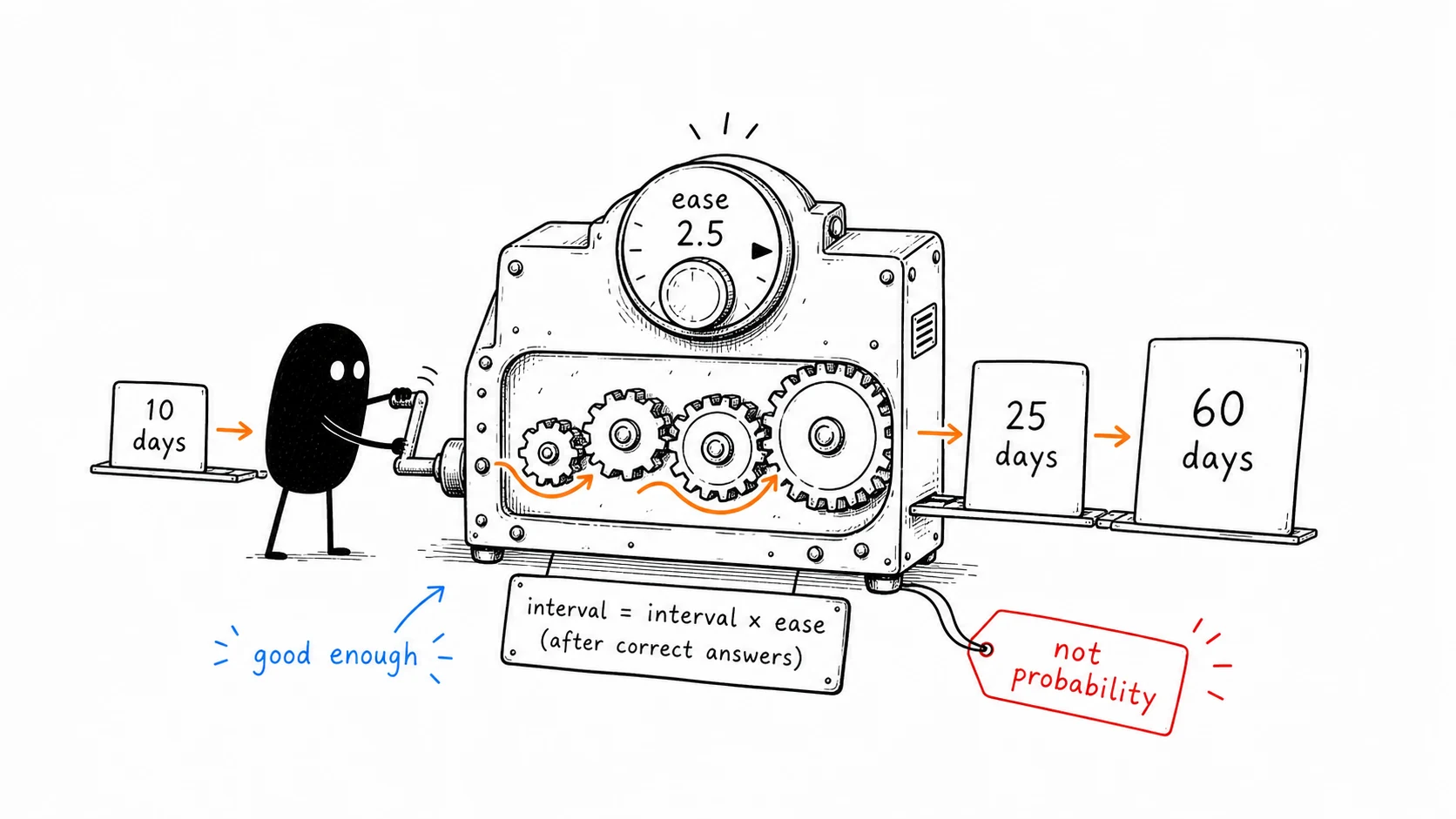
The weakness is the flip side of that simplicity. SM-2 doesn't really model forgetting — it can't tell you the probability you'll recall a given card today, it just applies a formula. In practice, this often leads to overly conservative intervals, forcing you to review cards more frequently than necessary.
Why FSRS is more accurate
FSRS, the Free Spaced Repetition Scheduler, is the modern answer. It was created by Jarrett Ye and is built on a memory model called DSR, which tracks three things SM-2 never makes explicit:
| What it means | Does SM-2 model it? | |
|---|---|---|
| D — Difficulty | How inherently hard this card is for you | No (ease is a rough proxy) |
| S — Stability | How long the memory stays above the recall threshold | No |
| R — Retrievability | Your probability of recalling it right now | No |
Because FSRS estimates your actual probability of recall, it can schedule each card for the moment you're about to forget it instead of guessing with a fixed multiplier. You also set a target, called desired retention (say 90%), and the algorithm aims your whole schedule at that number. It even trains on your own review history, so it adapts to how you forget rather than assuming everyone is the same.
The results back it up. Benchmarked on more than 500 million real Anki reviews, FSRS needs roughly 20–30% fewer reviews than SM-2 for the same retention, and in about 99.6% of collections FSRS-6 predicts recall more accurately (lower log loss) than SM-2. One honest caveat: that efficiency figure comes from large-scale simulation on logged data, not a controlled trial with live students. The community was convinced anyway. Anki added FSRS as an option in version 23.10 (November 2023); as of mid-2026 it's one toggle away in deck options, though still not the default.
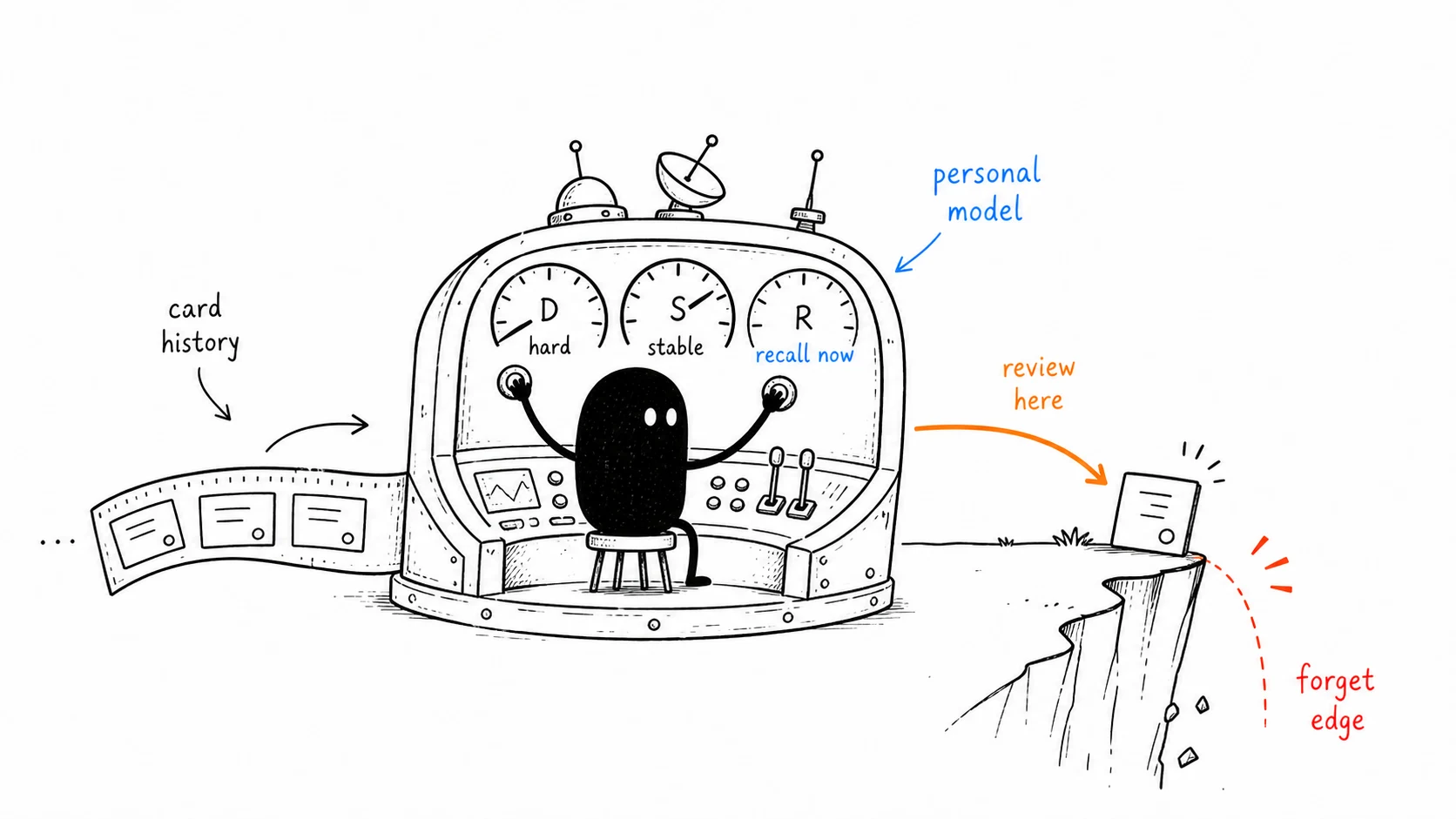
So the short version: SM-2 is a good 1987 heuristic, FSRS is a 2020s model that actually predicts forgetting. If you're choosing today, FSRS wins.
How a normal person should actually use it
The algorithm matters less than the habit. Here's what works regardless of which scheduler is under the hood.
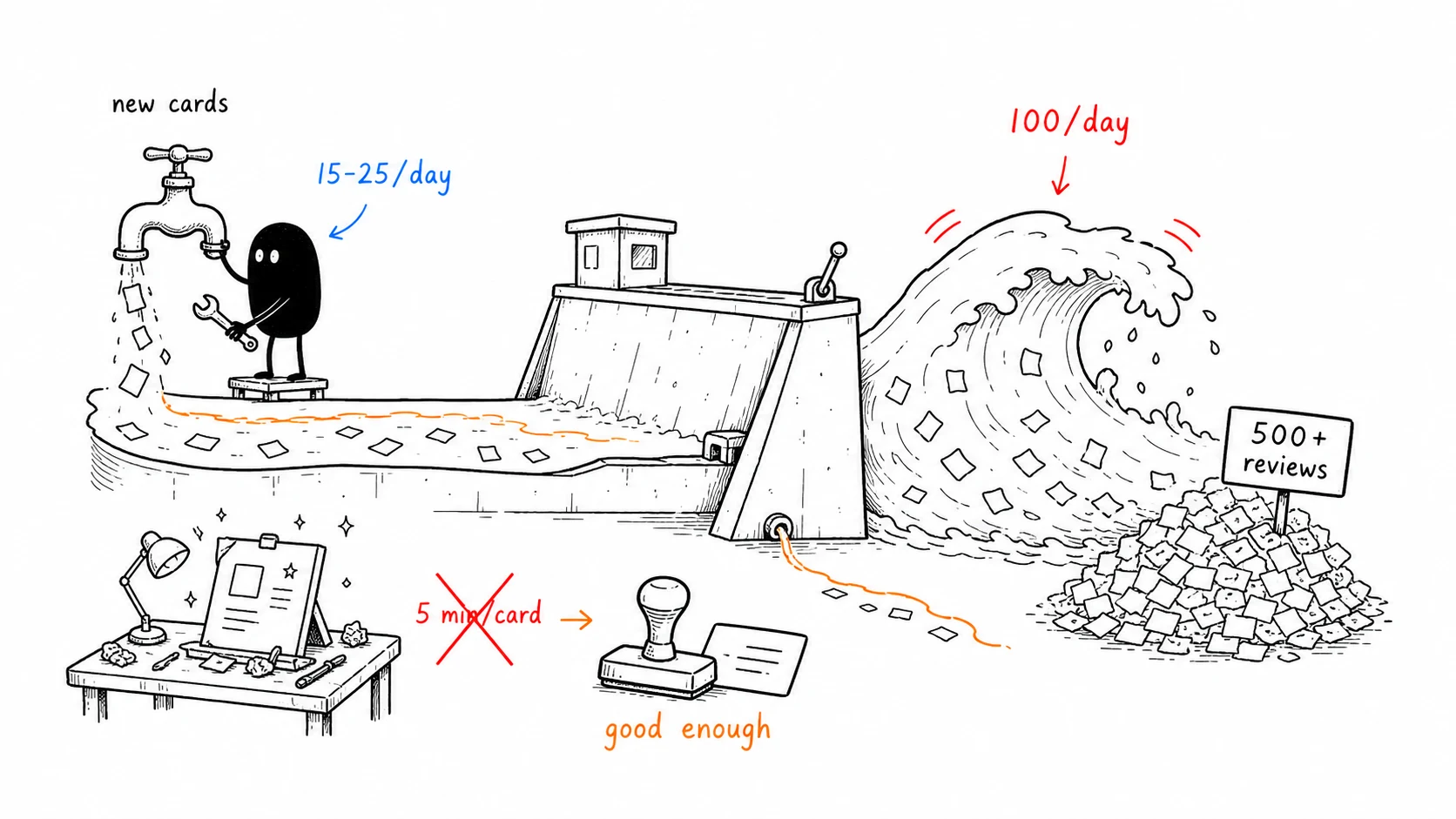
Cap your new cards. Every new word you add today creates 5 to 7 future reviews over the next month. Add 100 a day and within weeks your daily pile is 500+ and you quit. For most people 15–25 new cards a day is the sustainable ceiling. The limit isn't how many words you can absorb in one sitting, it's how big the review backlog grows. If that compounding is hard to picture, map it onto real dates with the study schedule maker — it plots the daily review load group by group and flags your peak day before you hit it.
Review daily, briefly. Ten minutes every day beats two hours every Saturday. SRS only works if you clear the due cards roughly when they come due; skip a few days and the queue snowballs, which is the number one reason people abandon it. For more on the routine, see how to learn vocabulary faster.
Don't over-polish cards. A card is a tool, not an art project. Thirty seconds for a decent card beats five minutes for a perfect one.
Trust the schedule. Don't review ahead "just to be safe." A card you see before it's due is one you almost certainly still remember, so it's mostly wasted effort. Let the algorithm decide when.
Where KaChiKa fits
The honest bottleneck here isn't the algorithm, it's card creation. Building one good Anki card by hand (word, meaning, example sentence, image, audio) takes around 5 minutes, and that friction is why most people stall in week one.
KaChiKa removes that step. Point your camera at a page or menu and the AI turns the words into cards in seconds, using the actual sentence from your photo as the example. It skips anything you already know, keeps the picture on the card for visual recall, and schedules reviews with the same FSRS algorithm Anki offers.
It is free to start on iOS and Android with no account required (Anki's iOS app alone is $25). It supports English, Korean, French, Chinese, Spanish, and Italian, alongside a dedicated Japanese (JLPT) edition.
Get started
You don't need to understand the math to benefit from it. Pick a tool that uses a modern scheduler, cap your new cards, and show up for ten minutes a day. The algorithm handles the rest.
If you want the SRS without building decks by hand, download KaChiKa free and photograph a page or menu — cards appear in seconds. For more on the Anki side, see the head-to-head KaChiKa vs Anki or the migration guide how to switch without losing your streak. Still comparing tools? Here are other Anki alternatives worth trying.
FAQ
What is a spaced repetition algorithm?
It's the math that decides when a flashcard app shows you each card again. It works off the forgetting curve: every time you recall a card correctly, the next review is pushed further out (days, then weeks, then months); when you miss one, it comes back soon. The two best-known ones are SM-2 (Anki's classic scheduler) and FSRS (the modern successor).
What is the difference between SM-2 and FSRS?
SM-2 is a simple 1987 formula from SuperMemo that adjusts intervals using a single per-card 'ease factor.' FSRS (Free Spaced Repetition Scheduler) is a newer, data-driven model that estimates your probability of recalling each card and schedules reviews right before you're likely to forget it. Benchmarks on 500M+ Anki reviews show FSRS needs about 20–30% fewer reviews for the same retention.
Does Anki use SM-2 or FSRS now?
Both are available. Anki ran on SM-2 for most of its history and added FSRS as an option in version 23.10 (November 2023). As of mid-2026 FSRS is built in but still off by default — you enable it with one toggle at the bottom of the deck options page.
How many new cards should I add per day?
For most people 15–25 new cards a day is the sustainable ceiling. Each new card creates roughly 5–7 future reviews over the next month, so adding 100 a day buries you under a daily backlog of 500+ reviews within weeks. The bottleneck is never how much you can learn in one sitting; it's how fast your review backlog grows.
Is there a free spaced repetition app that doesn't make you build cards by hand?
Yes. KaChiKa is free to start on iOS and Android with no account required. Photograph a page and it turns the text into vocabulary cards in seconds, using the real sentence from your photo as context, and schedules reviews with FSRS spaced repetition. For comparison, Anki's iOS app alone costs $25.
Why are my FSRS intervals so long?
A long interval is FSRS working as designed, not a bug. It schedules the next review for the point where your chance of recalling the card drops to your desired retention (90% by default), so a card you've answered correctly a few times can be scheduled months into the future simply because its stability is genuinely high. If the gaps feel too aggressive, nudge your desired retention up a few points rather than reviewing early.
Should I trust FSRS, or review every day to be safe?
Trust it. A card you see before it's due is one you almost certainly still remember, so reviewing early is mostly wasted time and doesn't make the memory much stronger. FSRS already aims each card at the last useful moment. Your only job is to show up daily and clear what is actually due — skipping days is what causes review queues to snowball, not the length of the intervals.
What desired retention should I use in FSRS?
80–90% is the sweet spot for most people, and the 90% default is a fine place to leave it. Pushing toward 95% and up feels safer, but it balloons your daily review count for marginal retention gains; dropping below 80% saves reviews at the cost of forgetting noticeably more. A practical pattern: keep it around 90% day to day and bump it up for a week or two before an exam.
Will switching from SM-2 to FSRS mess up my existing cards?
No. FSRS reads your past review history and fits its parameters to how you actually forget, so your existing cards keep their progress and just get scheduled more accurately. You don't need to reset anything. Run the optimizer once you've logged a few thousand reviews so it has enough data to work from. And if you'd rather not tune any of this, apps like KaChiKa run FSRS with nothing to configure.
