Duolingo vs Anki: Which One Actually Helps You Remember Vocabulary?
Duolingo recently surpassed 113 million monthly active users. Anki has powered the study habits of med students and polyglots for almost two decades. Both are wildly popular — and both leave a real gap in vocabulary retention.
This article compares Duolingo vs Anki for language learning: what each tool does well, where each falls short, and why a growing number of learners combine or replace them with photo-based flashcard tools that combine the best of both worlds.
Disclosure: KaChiKa, the third app in this comparison, is ours.
Quick Comparison: Duolingo vs Anki vs KaChiKa
| Feature | Duolingo | Anki | KaChiKa |
|---|---|---|---|
| Learning style | Gamified lessons | Manual flashcards | Photo-to-card AI |
| Time to first card in SRS | Never (fixed lessons) | Custom cards: multi-step lookup & format (or instant with shared decks) | ~5 sec / photo |
| Spaced repetition | Hidden, course-controlled | ✅ SM-2 (FSRS opt-in) | ✅ Modern FSRS |
| Visual context | Cartoon illustrations | Optional, user-supplied | Your own real-world photos |
| Daily routine fit | Dedicated 10–15 min lesson | Dedicated study sessions (desktop or mobile) | Quick daily life captures (1–2 min) |
| Card creation overhead | None (pre-made) | Higher for custom cards; lower with shared decks | Automated (generates in ~5s from a photo) |
| Motivation driver | Streaks, XP, leagues | Pure self-discipline | Low startup friction + FSRS |
| Free tier | Yes (energy limits) | Free desktop / $25 iOS | Free to start (AI limits) |
| Best for | Beginners, streak motivation | Power users, exam prep | Low-friction daily habit |
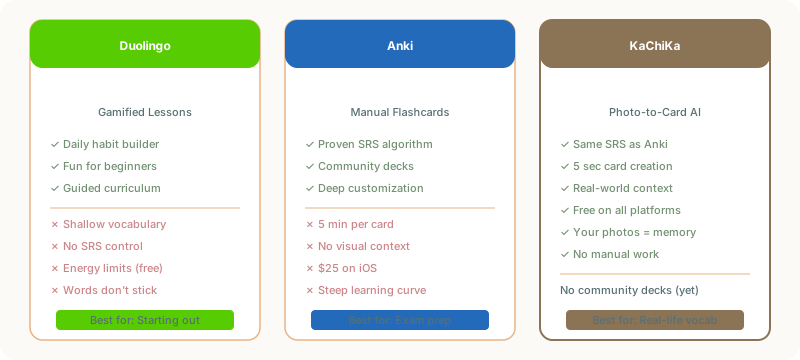
1. Duolingo: Fun to Start, Hard to Retain
Duolingo nails one thing: getting you to open the app every day. The streak counter, XP, leagues, and friendly owl nudges create a daily habit that no other language app has matched at scale.
But there's a gap between daily app usage and actual vocabulary retention. Language learners often report that long streaks can build an app habit without necessarily developing conversational recall. The pattern is consistent: Duolingo teaches you to recognize answers within the app, not to recall words in the real world.
Where Duolingo falls short
-
Shallow vocabulary coverage. Lessons teach isolated phrases and random sentences ("The duck wears a hat") with little connection to your actual life. The words don't stick because they never connected to anything real in the first place.
-
No real spaced repetition control. Duolingo has an internal review system, but you can't see or control it. If you want to drill a specific word you keep forgetting, there's no way to do it. The algorithm decides what you see.
-
The energy system. In 2024–2025, Duolingo replaced hearts with an energy system that limits how many lessons you can do per day — even if you answer correctly. Free users hit walls; paid users don't. This monetization change pushed many learners to look for alternatives.
-
Repetition without depth. Later lessons often recycle the same sentence patterns. Learners report feeling like they're "playing a game" rather than building real language ability, especially once they move past the absolute beginner stage.
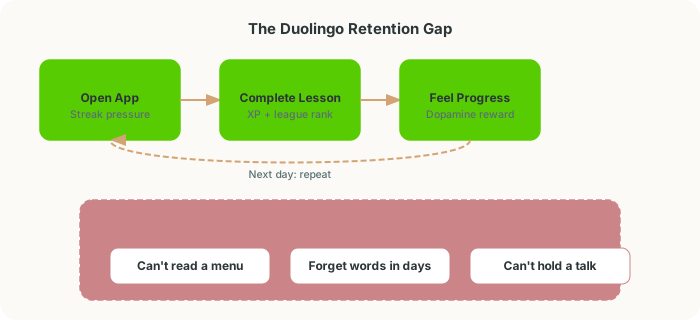
2. Anki: Powerful but Demanding
Anki is the opposite of Duolingo. No gamification, no hand-holding, no pre-built path. You build your own flashcards, configure your own settings, and review on your own schedule. The spaced repetition algorithm (SM-2, or the newer FSRS) is battle-tested and genuinely effective.
For medical students memorizing 20,000 terms or JLPT candidates drilling kanji, Anki is still unmatched. The community deck library is enormous — especially for standardized tests like JLPT, TOEIC, and USMLE — and the customization options are deep.
Where Anki falls short
-
Card creation is the bottleneck. Building custom cards — word, translation, example sentence, image, audio — requires deliberate formatting and dictionary lookup. For learners who want personal vocabulary rather than pre-made decks, this setup time can become a friction point before reviewing even begins.
-
No built-in context. A typical Anki card shows a word on a white background. Even with an image field, most users grab a generic stock photo. There's no scene, no moment, no personal connection to anchor the memory.
-
Steep learning curve. The Anki manual is over 100 pages. Note types, card templates, deck options, add-ons, sync — the setup cost is real. Many learners download a shared deck, get overwhelmed by the review queue, and abandon it within weeks.
-
iOS costs $25. Anki is free on desktop and Android, but the iOS app requires a $24.99 upfront purchase. For phone-first learners, this is a real barrier.
If you've been through the Anki grind and want something lighter, we wrote a full guide on how to switch from Anki without losing your study habit.
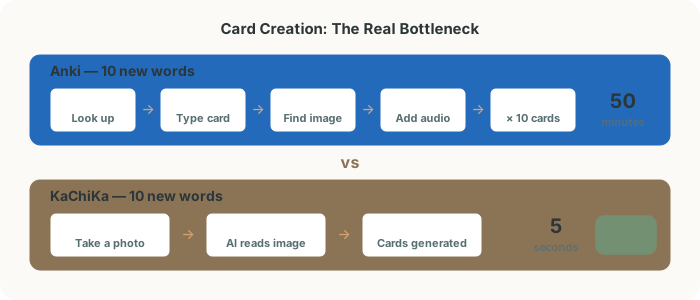
3. The Real Problem: Neither Tool Connects Words to Your Life
Here's what both Duolingo and Anki miss: the words you actually need are the ones around you right now.
The coffee shop menu you can't read. The street sign in Tokyo. The ingredient list at a foreign grocery store. The email from a colleague in another language. These are the words that matter — and neither Duolingo's pre-scripted lessons nor Anki's blank card editor makes it easy to capture them.
Cognitive science backs this up. Encoding specificity — the principle that memories are strongest when the retrieval context matches the encoding context — suggests that words connected to personal, real-world visual scenes provide richer situational retrieval cues than generic illustrations or plain text cards.
This is exactly the gap that photo-based visual memory tools fill. (For the science behind why this works, see our deep dive on spaced repetition algorithms.)
4. Streaks vs. Habits: Why Startup Friction Decides Who Quits
Many learners who say "I can't stick with language learning" blame their willpower. In habit design research (such as James Clear's Atomic Habits or BJ Fogg's behavior models), one key insight is consistent: habits are much harder to maintain when the activation energy is high.
When evaluating Duolingo and Anki through the lens of startup friction, their different trade-offs become clear:
Building custom cards creates high startup friction in Anki
Anki's FSRS algorithm is mathematically powerful for scheduling reviews. If you use a pre-made shared deck, you can start reviewing right away. However, many learners want to study words from their own lives, jobs, or reading. Building custom cards — looking up definitions, selecting example sentences, adding images, and formatting fields — takes considerable time per card. On busy or exhausting days, the mental friction of managing card templates and dictionaries often leads learners to postpone the session, which can cause review backlogs to accumulate.
Streaks encourage opening the app, but context determines retention
Duolingo minimizes startup friction by offering pre-packaged, bite-sized lessons. Tapping a button to keep a streak alive is psychologically easy. However, gamified streaks primarily reward app engagement. When lessons rely on isolated sentences detached from personal routines, learners often find that recognition within multiple-choice quizzes does not translate into conversational recall.
Habit stacking: attach study to an anchor you already have
A practical way to build consistency is habit stacking: connecting a brief learning action to an established daily routine.
(Note: If you are learning Japanese, this photo workflow is available in the dedicated KaChiKa JA edition; for other languages like Spanish, French, or Korean, use multi-language KaChiKa).
| Daily Anchor | What to Shoot | Example Words Captured (varies by scene) | Typical Time |
|---|---|---|---|
| Morning breakfast | Plate, mug, packaging | Bread, coffee, milk, tableware | ~5 seconds to generate |
| Commute to station | Ticket gate, signs, ads | Entrance, ticket, direction, map | ~5 seconds to generate |
| Lunch table | Restaurant menu, condiments | Menu, order, water, seasonings | ~5 seconds to generate |
| Evening wind-down | None (review queue) | Review due cards (offline-ready) | Varies by queue size |
Because snapping a photo takes seconds and requires no manual typing, capturing new vocabulary creates minimal friction in a daily routine.
5. KaChiKa: The Middle Ground
KaChiKa takes Duolingo's low-friction entry and Anki's proven spaced repetition, then replaces both the gamified lessons and the manual card-building with one action: take a photo.
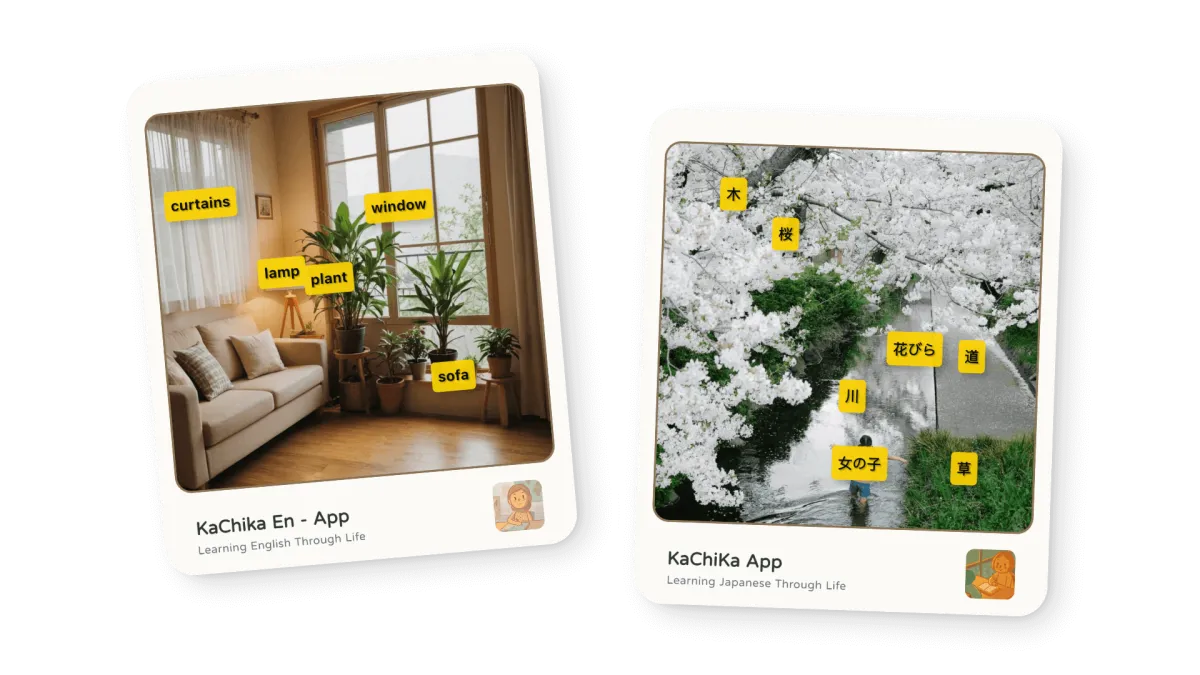
Here's how it works:
- Snap a photo of anything around you — a menu, a train sign, your desk, a receipt.
- AI reads the image, identifies interactive word tags, and generates cards in about 5 seconds with target-language words, everyday sentences, short dialogues, and pronunciation.
- Modern FSRS algorithm (the app uses a Dart port of the open-source FSRS algorithm) schedules your reviews automatically. Reviews work fully offline.
- Zero account friction: no sign-up required, no login. Your cards and study history live on your device — no cloud library. (Making a card sends the photo for AI analysis).
A single photo identifies key objects and text in about 5 seconds, turning what could be a multi-step dictionary-and-editor workflow into a single tap.
The key difference from Duolingo: every card comes from your real world, not a generic cartoon lesson. The key difference from Anki: you never touch a card editor or fiddle with note templates.
For a detailed feature-by-feature breakdown, see our KaChiKa vs Anki comparison.
6. When to Use Which Tool
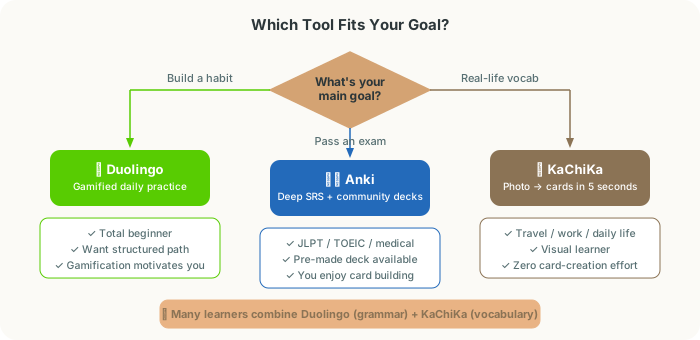
There's no single best tool for everyone. Here's a practical decision guide:
Stick with Duolingo if:
- You're a complete beginner who needs the external structure of a guided syllabus
- You prioritize gamification (streaks, leaderboards) and structured momentum over deep vocabulary customization
- You want an easy, entertaining introduction before tackling serious vocabulary
Stick with Anki if:
- You're studying for a standardized exam (JLPT, TOEIC, USMLE) and rely on massive community-curated decks
- You want complete control over fields, CSS card styling, and custom scheduling parameters
- You genuinely enjoy the manual deck-building and card curation process
Switch to KaChiKa if:
- You've quit language apps multiple times because the session itself was too heavy to start — a 5-second photo is a micro-habit you can finish before your coffee cools
- You want the retention power of modern FSRS without the manual card-creation tax or a $25 iOS fee
- You learn languages for real-life travel, work, and communication, where seeing a word in its real setting makes it stick
- You value privacy and simplicity: no sign-up required, cards stored on your device
Note for Japanese learners: If you are specifically preparing for JLPT or studying Japanese, use the dedicated edition KaChiKa JA (the multi-language app supports English, Korean, French, Chinese, Spanish, and Italian, while KaChiKa JA is built exclusively for Japanese).
Or combine them:
You can use Duolingo for grammar structure + KaChiKa for real-world vocabulary. Duolingo introduces the pattern; KaChiKa makes the words stick by tying them to moments you've actually lived.
7. What About Quizlet, Memrise, and Others?
You might wonder where other popular tools fit. Quizlet is strong for pre-made study sets and classroom use, but its Learn mode uses adaptive practice rather than true spaced repetition scheduling, and many features are behind a paywall. Memrise offers video clips from native speakers, good for listening exposure but limited for building your own vocabulary. Drops has beautiful visual design but no real spaced repetition engine underneath.
None of these solve the core friction: getting real-world words into a proven SRS system without manual work. That's the specific gap photo-based flashcards address. For a full comparison, see our Top Anki Alternatives in 2026.
8. The Forgetting Curve: Why Method Matters More Than Time
Ebbinghaus's forgetting curve illustrates how newly encountered vocabulary fades without timely reinforcement. Spaced repetition counteracts this decay by scheduling reviews before memory traces drop below retrieval thresholds.
Duolingo's hidden algorithm tries to handle this, but you can't control it. Anki gives you full control but demands you build or import cards first. KaChiKa automates card creation from photos and schedules reviews using the modern FSRS algorithm.
The math is proven across cognitive science. What differs is the friction between "I saw a new word" and "that word enters my spaced repetition system." With Duolingo, you wait for the course to introduce it. With custom Anki cards, you build them manually. With KaChiKa, you take a photo.
The lower the friction, the more words actually make it into your review cycle — and the more you retain.
Bottom Line
Duolingo gets you started. Anki gives you the algorithm. KaChiKa removes the friction between seeing a word in the real world and retaining it for the long haul.
If you've been using Duolingo for months and feel like you're spinning your wheels, or if you know Anki works but can't keep up with card creation, photo-based vocabulary learning is worth a try.
Try it yourself: Download KaChiKa free (learning Japanese? Get KaChiKa JA). Already an Anki user? Read our guide on Top Anki Alternatives in 2026 for a wider comparison.
FAQ
Is Duolingo or Anki better for learning vocabulary?
It depends on your goal. Duolingo is effective for getting beginners into a daily routine with gamified lessons, though vocabulary retention can feel disconnected from real-life situations. Anki is unmatched for long-term memory retention thanks to its spaced repetition algorithms, but building custom cards with personal context requires setup effort (though pre-made community decks can reduce this). Photo-based flashcard tools like KaChiKa combine FSRS-based spaced repetition with card generation from your own photos in about 5 seconds.
Why do I forget words I learned on Duolingo?
Duolingo teaches you to recognize answers within its app interface, not to recall words in real-world contexts. Its lessons use isolated, often random sentences with no connection to your life. Without strong contextual encoding and controlled spaced repetition, the words fade quickly. Adding a dedicated SRS tool for vocabulary review significantly improves retention.
Is there a free alternative to both Duolingo and Anki?
Yes. KaChiKa is free to start on iOS and Android (the free tier has AI-generation limits; Pro is $2.99/mo or $29.99/yr). It uses modern FSRS spaced repetition algorithms but generates flashcards automatically from photos in about 5 seconds — no manual card creation needed and no sign-up required. Unlike Duolingo, every card comes from your real-world context, and unlike Anki, there's no $25 iOS fee.
Can I use Duolingo and Anki together?
Yes, a practical approach is to use Duolingo for grammar structure and a flashcard app for vocabulary retention. The combination works because Duolingo introduces patterns while SRS-based flashcards ensure individual words stick. You can pair KaChiKa with Duolingo to capture real-world vocabulary from photos alongside structured grammar lessons.
What is the Duolingo energy system and why are people leaving?
In 2024-2025, Duolingo replaced its hearts system with an energy system that limits daily lesson completions for free users, even when answering correctly. This monetization change, combined with repetitive later content and shallow vocabulary depth, has driven many learners to seek alternatives or supplement Duolingo with dedicated vocabulary tools.
Which app is best for building a daily language-learning habit?
Gamification apps like Duolingo excel at initial motivation through streaks and notifications, but maintaining momentum is easier when startup friction is minimal. Pairing an existing daily anchor (such as morning coffee or daily commute) with taking a photo in KaChiKa creates a quick micro-habit that fits into busy days without opening complex card editors.
I keep quitting Japanese study — what actually helps?
For Japanese learners, study habits often stall when organizing kanji lists or building custom flashcards becomes heavier than the actual review. Using the dedicated JLPT edition KaChiKa JA lets you snap photos of menus, signs, and textbooks to generate vocabulary cards with everyday sentences, short dialogues, and audio in about 5 seconds, with reviews scheduled by FSRS.
