The Ebbinghaus Forgetting Curve: Why You Forget Two-Thirds in a Day — and the Schedule That Beats It
Monday night, you sit down with 50 new Spanish words and drill them for two hours. By the end you know every single one. Wednesday morning, about half are gone. Open the list again on Saturday and it might as well belong to someone else.
That's not a discipline problem, and it's not a talent problem. It's the normal operation of human memory, measured with remarkable precision by the German psychologist Hermann Ebbinghaus back in 1885. The graph he produced is the forgetting curve: a measurement of how fast memory drains without review.
This article covers what Ebbinghaus actually found, why the cram-then-reread study method walks straight into the curve, and the exact spaced repetition schedule that beats it. At the end I'll get to the tools that run the schedule for you, because nobody runs it by hand.
If you only need the dates, the free review schedule generator turns a start date into a day-by-day plan you can export to your calendar. The reasoning behind those intervals follows below.
What Ebbinghaus actually measured in 1885
Ebbinghaus had no lab and no test subjects, so he used himself. He memorized lists of nonsense syllables — ZOF, KIB, XAR — then tested how much he could still recall at fixed intervals. The syllables were meaningless on purpose: real words carry associations, and associations contaminate the measurement.
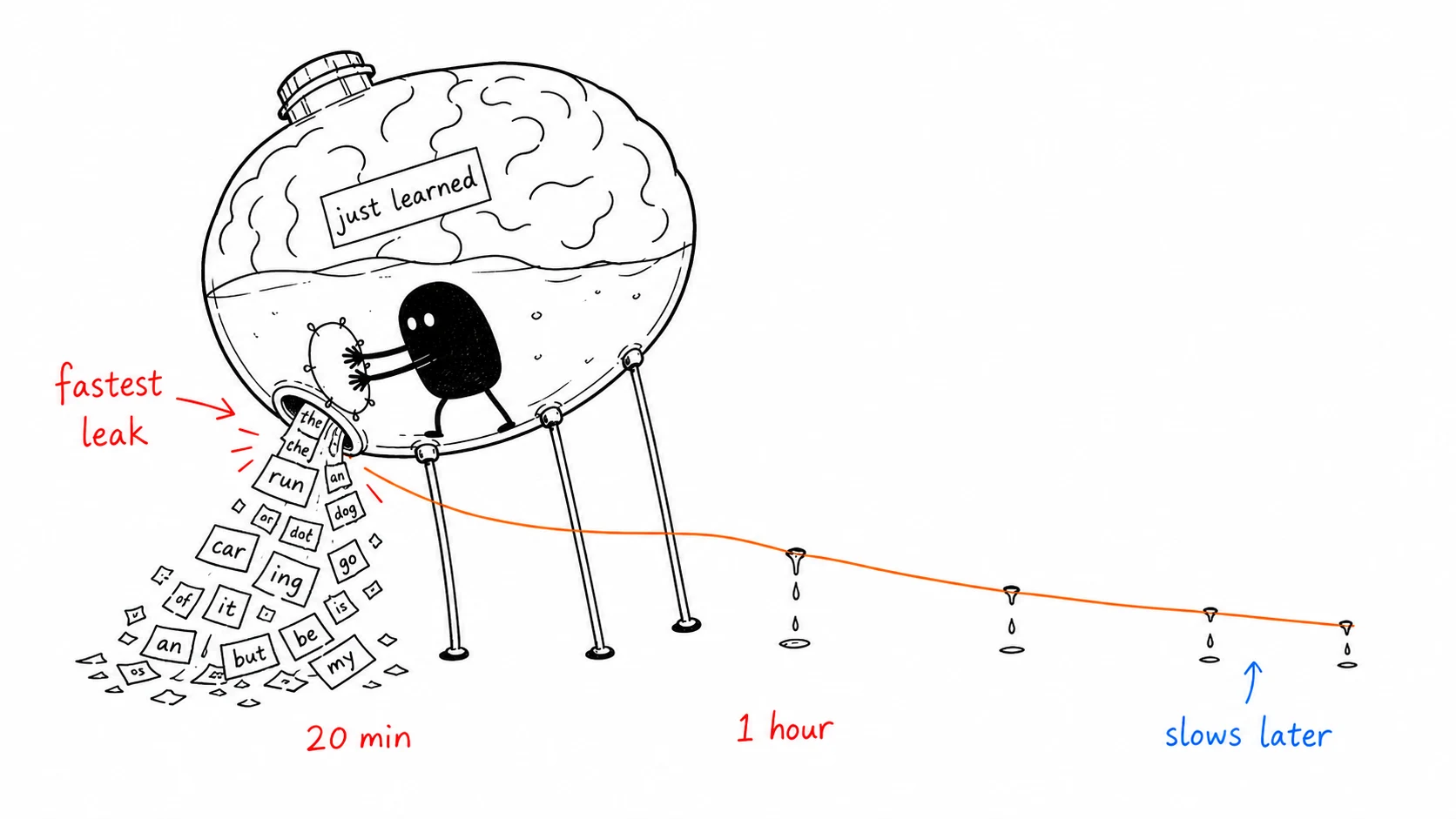
The result is simple. Memory drops fast early on. His numbers:
| Time after learning | Forgotten |
|---|---|
| 20 minutes | ~42% |
| 1 hour | ~56% |
| 1 day | ~66% |
| 6 days | ~75% |
| 31 days | ~79% |
The numbers show two things worth noticing.
First, the decay is front-loaded. You lose more in the first hour than in the following month. The window between 20 minutes and 24 hours after study is where the damage happens — which is exactly the window most study plans ignore.
Second, an honest caveat: these numbers come from one man memorizing deliberately meaningless syllables. Real vocabulary with context and imagery decays more slowly. However, the shape of the curve holds up — as confirmed by a 2015 replication study. That trajectory is what matters: steep initial loss, followed by a stabilizing plateau.
The second finding everyone skips
If Ebbinghaus had only mapped the decay, he'd be a footnote. His more useful discovery is what happens when you review:
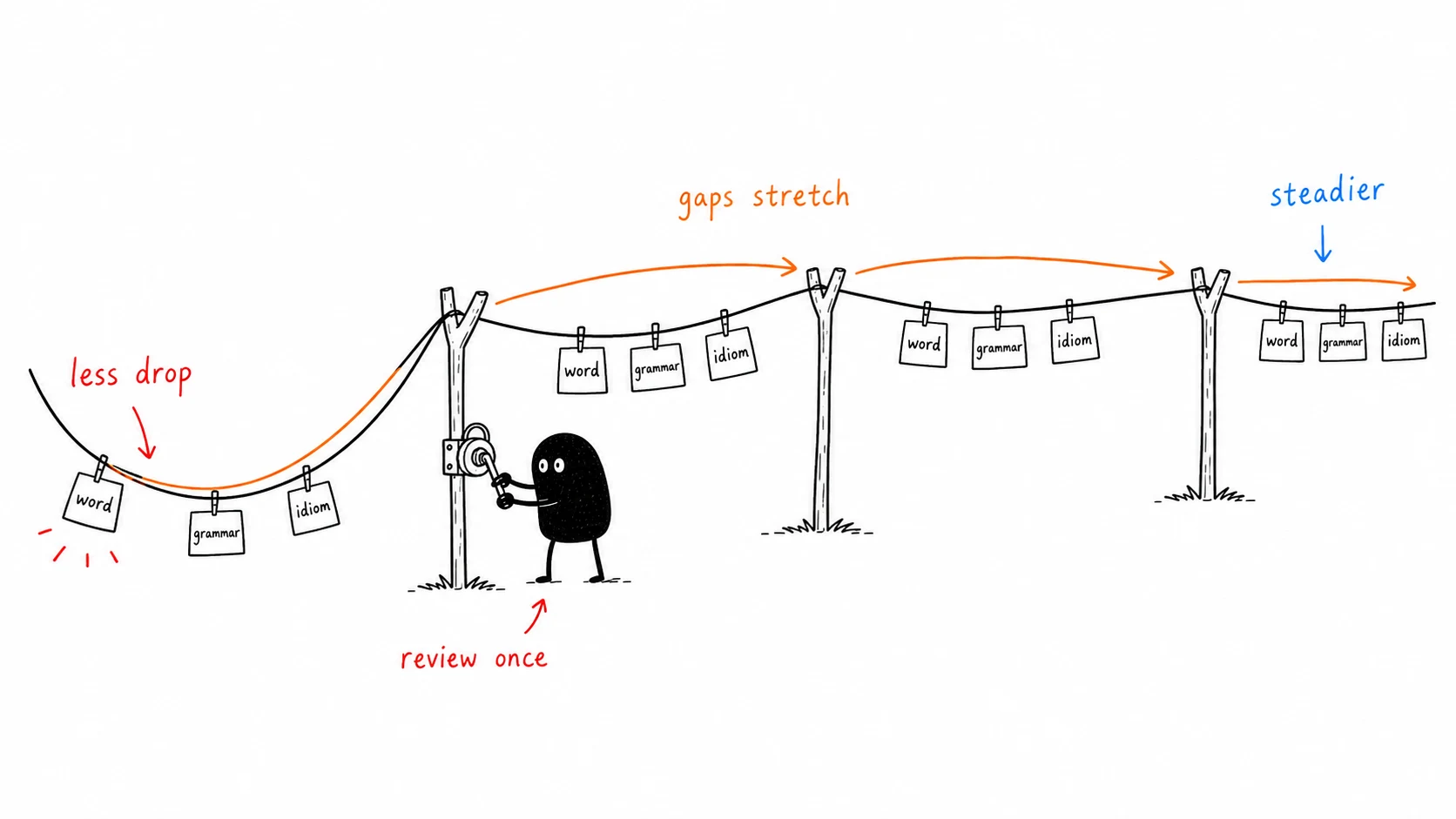
A successful review makes the next round of forgetting happen more slowly.
The pattern runs roughly like this:
- Learn a word today → a day later, ~66% chance it's gone
- Review it on day 2 → a day after that, only ~50% is lost
- Review again around day 7 → the next day costs you ~20%
- Review around day 30 → a full month later, ~10% gone
Each review flattens the curve, which means the gaps between reviews can keep growing — a day, then three, then a week, then a month — and the word still holds. This observation is the basis for spaced repetition. It's why a good flashcard app doesn't show you the same card every day: after each success, the card needs you less.
Why your study method fails (timing, not effort)
Back to the Monday-night scenario. Fifty words, two solid hours, half gone by Wednesday. Where exactly did it fail?
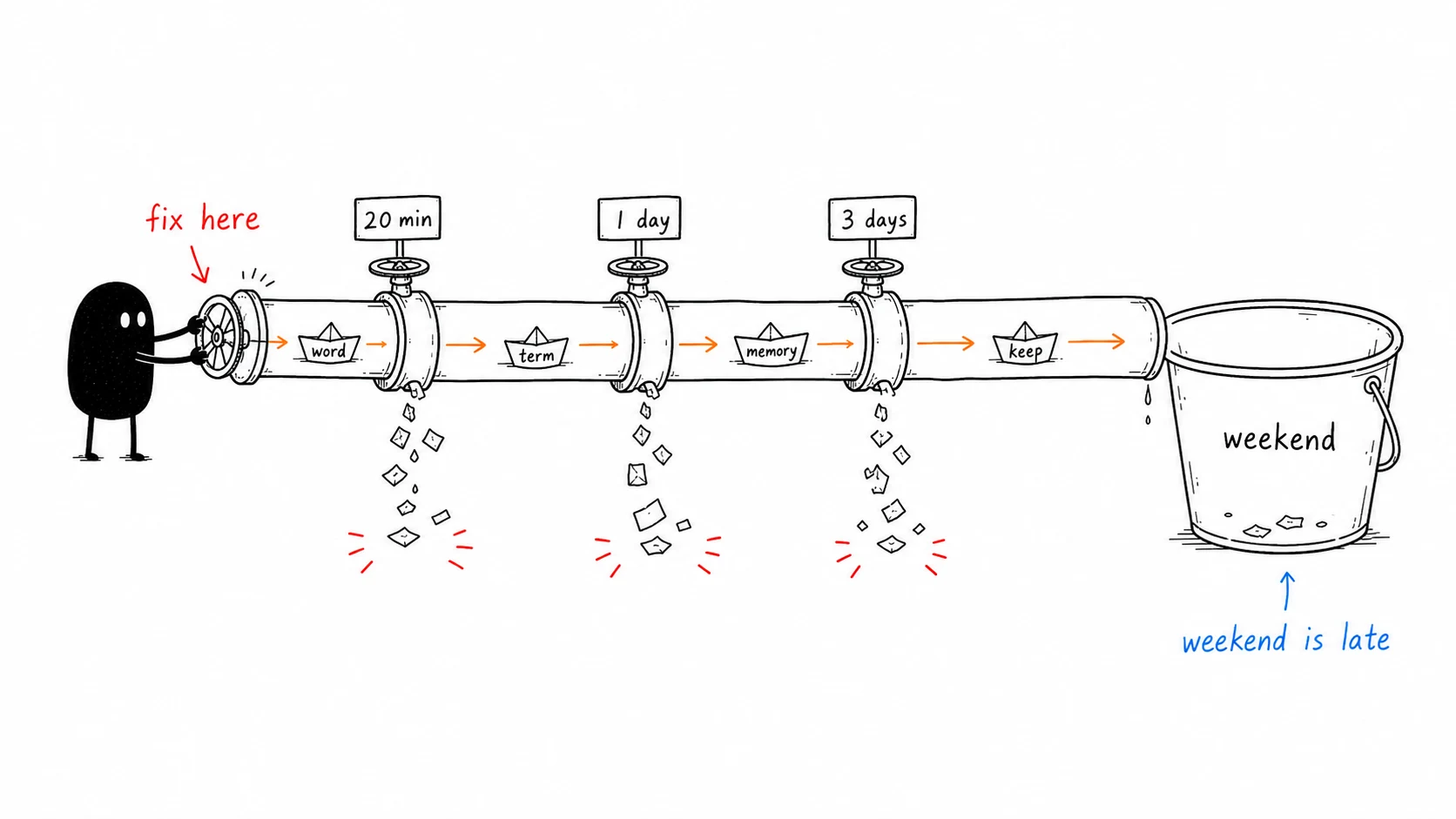
Not at the learning step. At the review step — or rather, the absence of one. By the curve, the first useful review should land around 20 minutes after study. Most students first look again five days later. By then roughly three-quarters is gone and the session is mostly relearning. Three-quarters of the Monday work produced nothing durable.
Cramming still feels productive, because recall is easy during the session. That fluency is fake — you're recognizing words you saw ninety seconds ago. The curve starts the moment you close the notebook.
How to beat the forgetting curve: the schedule
Here's a practical schedule built on the curve's principle, each review placed roughly where forgetting picks up speed:
| Review | When | What's happening |
|---|---|---|
| 1st | 20 minutes after learning | Catches the steepest part of the cliff |
| 2nd | 1 day later | Pulls the word toward long-term memory |
| 3rd | 3 days later | Gaps start stretching |
| 4th | 1 week later | Memory is stabilizing |
| 5th | 1 month later | Mostly consolidated |
| 6th | 3 months later | Effectively permanent |
Six brief touches over three months, most of them under ten seconds per word, and the word stays for good.
👉 Want this schedule mapped onto real dates? The free Ebbinghaus review schedule generator takes your start date and turns these intervals into a day-by-day plan you can export straight to your calendar.
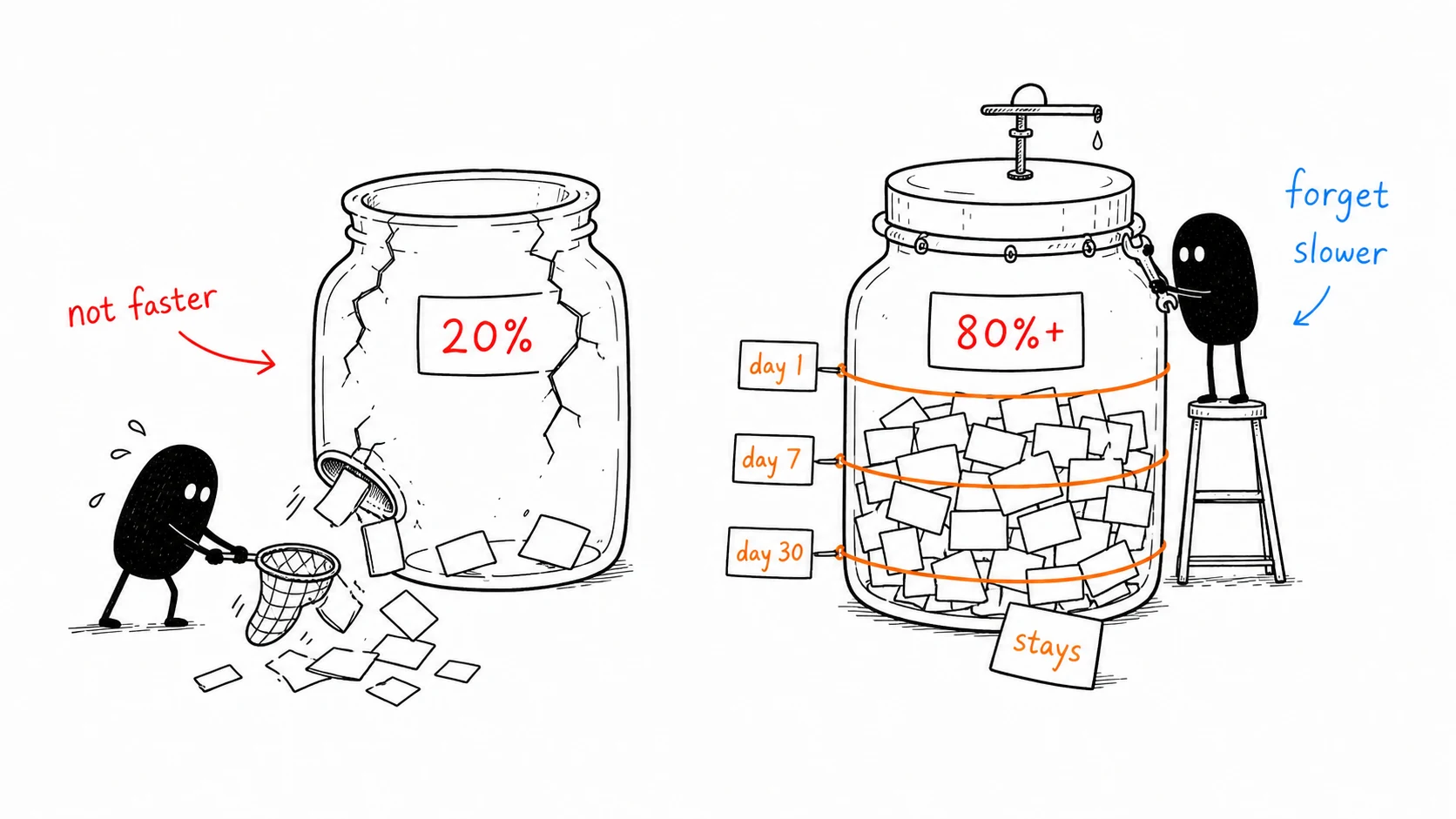
One expectation worth setting straight, because people get it wrong constantly: spaced repetition doesn't make you learn faster; it slows down how fast you forget. Study 100 words without it and roughly 20 survive a month later. Study the same 100 words on this schedule and 80-plus survive. The daily workload barely changes; the long-term retention quadruples.
Don't try to run this schedule by hand
Now the obvious problem. The table above is for one word learned on one day. Learn 20 words a day and within a month you're juggling hundreds of words, each on its own staggered schedule — some due today, some Thursday, some on the 14th. Tracking that on paper for a 1,000-word vocabulary is hours of pure bookkeeping. I once tried it with a spreadsheet. It survived nine days.
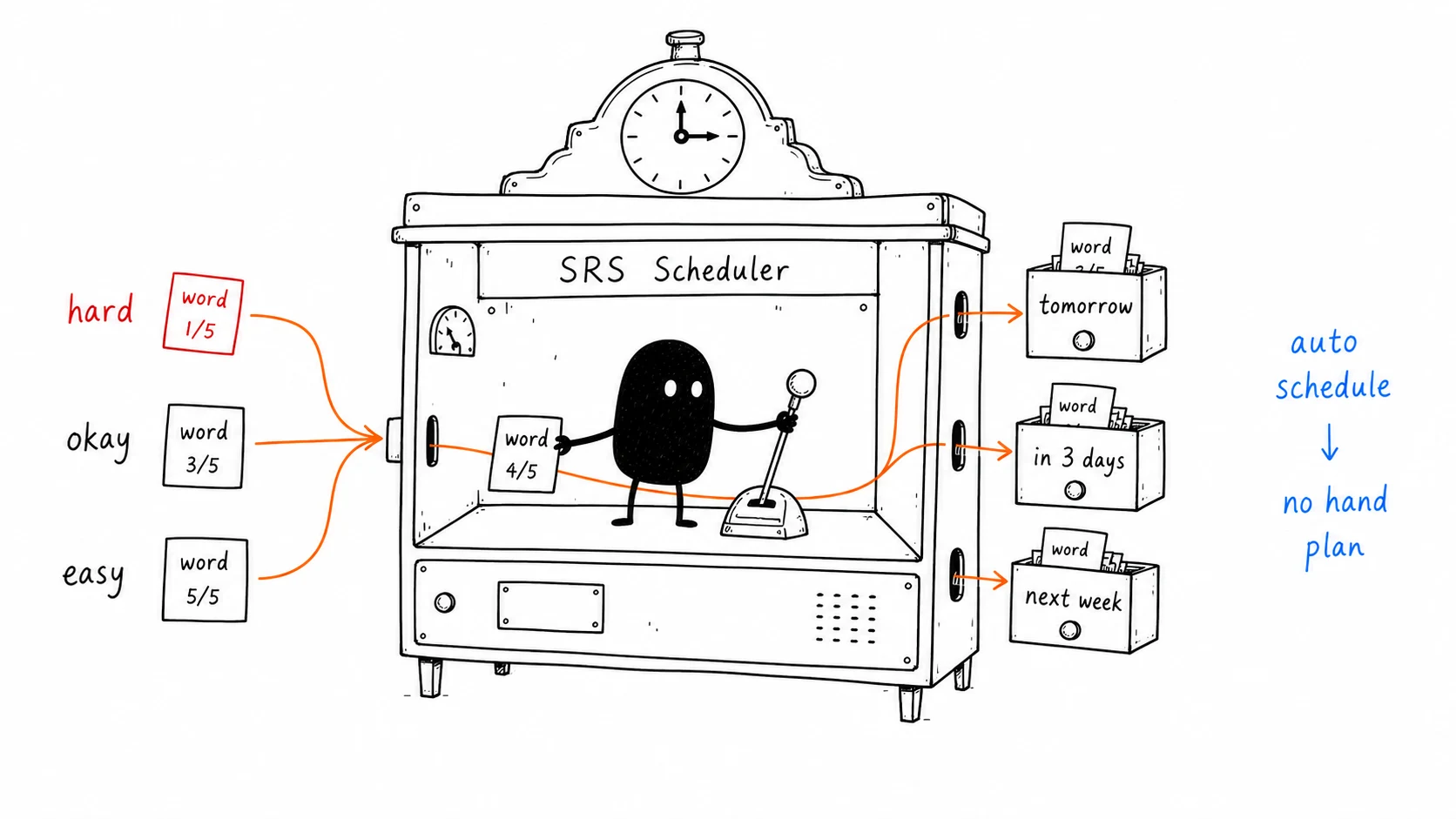
This is exactly the job software should do. An SRS (Spaced Repetition System) app stores every card's schedule and surfaces only what's due today. The classic algorithm is SM-2, built for SuperMemo in 1987 and used by Anki for most of its life. The modern one is FSRS, which models your personal forgetting rate instead of applying one formula to everyone. KaChiKa uses an FSRS scheduler. Anki added native FSRS in version 23.10. If you want the internals, I compared the two algorithms properly in SM-2 vs FSRS — for this article, it's enough to know that any modern SRS app automates the table above.
Five rules that make it actually work
The algorithm is the easy part. These habits decide whether it works.
1. Pick one tool and stay. The realistic options:
- Anki — free on desktop and Android ($25 one-time on iOS), endlessly customizable, and you build every card yourself.
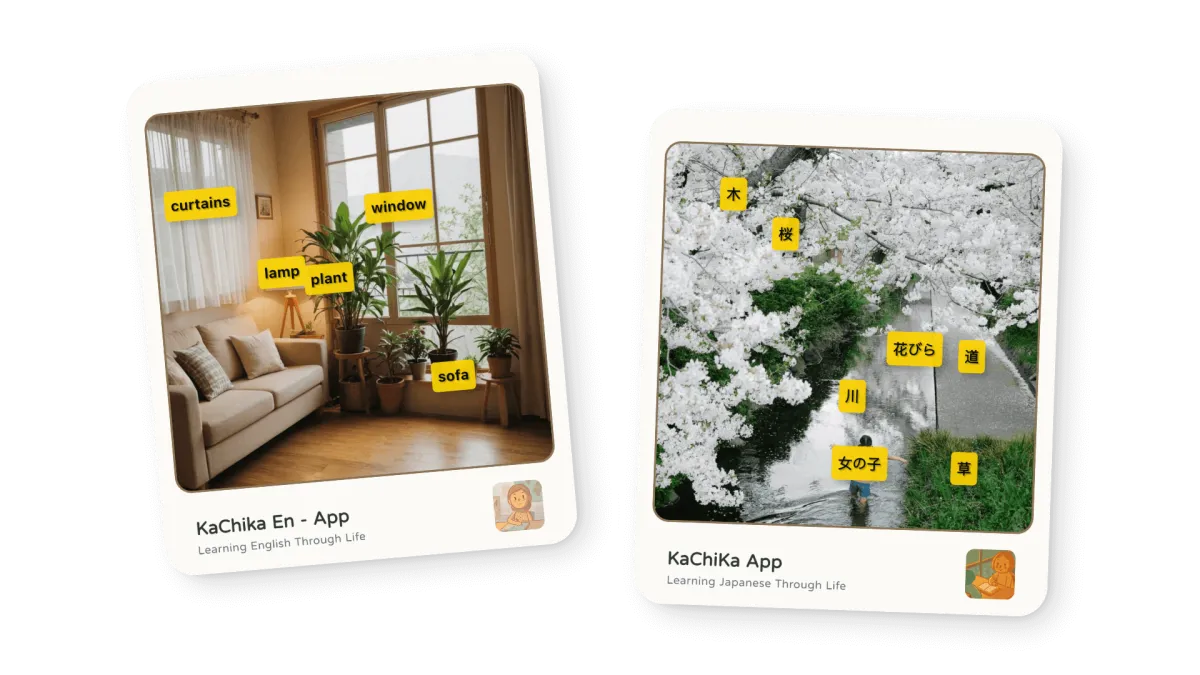
- KaChiKa — free to start; you photograph a page, a menu, a street sign, and AI builds the cards with image and example sentence attached.
- Quizlet — pleasant interface, but its spaced repetition is weaker than a true SRS.
- Memrise — ready-made courses, ongoing subscription.
My honest take: Anki's scheduling is excellent, and the price of admission isn't money — it's labor. A good card (word, meaning, sentence, image) takes about 5 minutes to build by hand, so a hundred cards is eight-plus hours of clerical work. That's where most people quit, usually in week one. If you'd rather spend those hours studying, start with KaChiKa and let the camera do the card-building.
2. Five to ten minutes a day. Not more. SRS rewards consistency, not volume. Ten minutes daily for a month beats a two-hour Saturday binge, because the schedule only works if you show up when cards come due. Skip four days and the queue snowballs, which is the number one reason people abandon SRS.
3. Grade yourself honestly. Rating a shaky card "Easy" so it goes away just schedules your own failure three months out. The grade is a measurement, not a reward. Lie to the algorithm and you're lying to yourself.
4. Cap new words around 20 a day. Every new word generates roughly 5–7 reviews over the next month. Add 100 a day and your daily review pile passes 500 within weeks — then you quit. Twenty a day still compounds to 600 words a month, which is plenty.
5. Never memorize a bare word. "Manzana = apple" is the weakest possible memory trace. The same word attached to a photo of the apple on your own kitchen counter, plus the sentence "Como una manzana cada mañana", is a different category of memory: visual plus contextual, an order of magnitude stickier. This is KaChiKa's default mode — one photo of your breakfast produces 5–10 cards, each arriving with the image and a usable sentence already on it, which saves you the image-hunting and sentence-writing that eats most of those 5 minutes per Anki card. More on the context principle in how to learn vocabulary faster.
What the curve can't fix
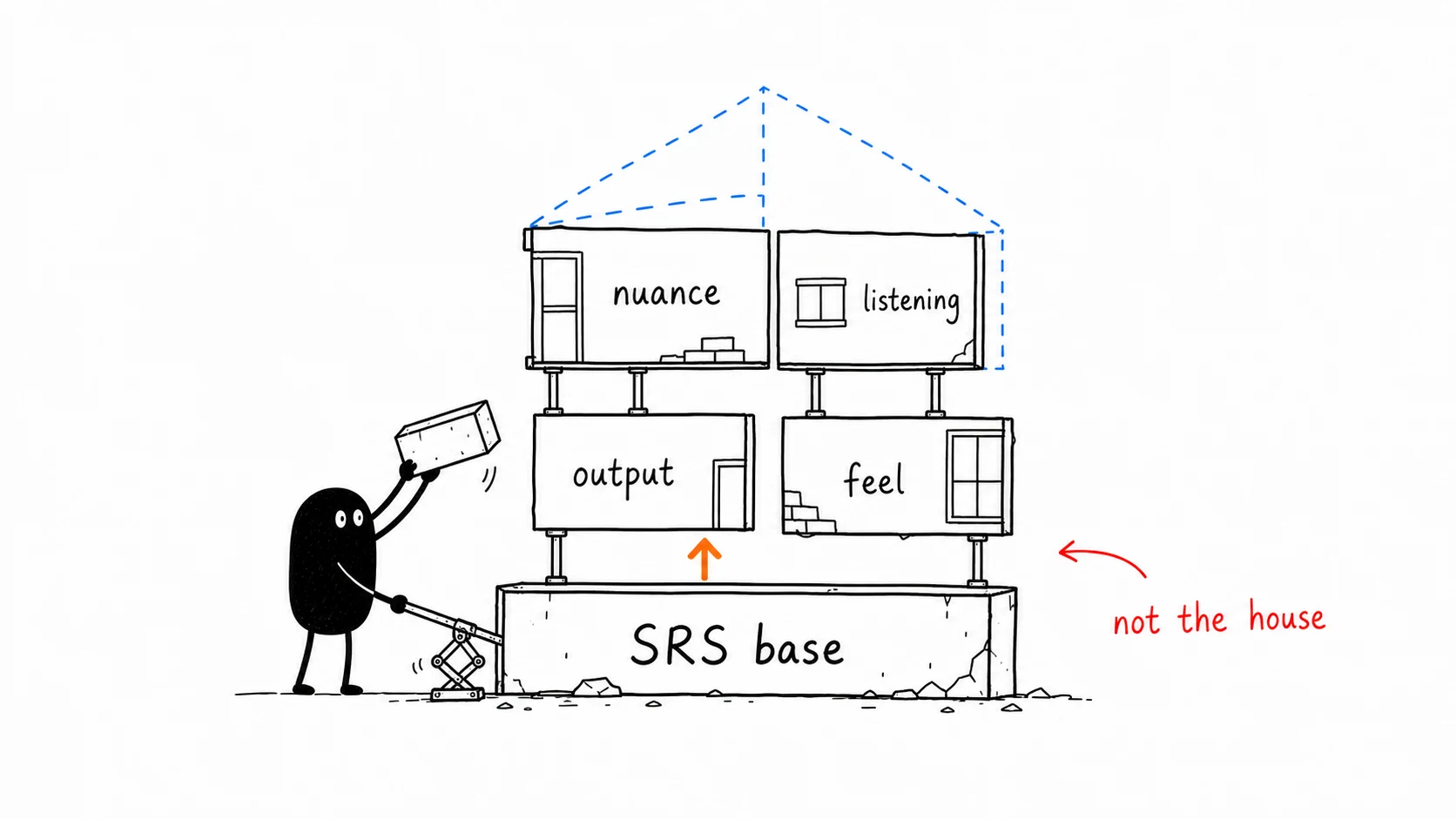
A quick reality check: the forgetting curve describes memory decay, and SRS addresses memory decay. That's one challenge out of several in language learning. SRS will not give you:
- Nuance. Cards help you remember that 見る means "to see"; they won't teach you when 観る or 視る fits instead. Same story with ser vs. estar.
- Listening. Recognizing a word on a card and catching it at native speed are separate skills.
- Output. Recognition is not production. Speaking needs speaking.
- Feel. The sense of what sounds natural only comes from volume — lots of reading and listening.
So the honest framing: SRS is the foundation, not the house. Build vocabulary on the curve's schedule, then spend the time it saves you on input and conversation.
Where this leaves you
Forgetting is not a personal failing. Without review, about two-thirds of new material is gone within a day. Reviews at widening intervals keep most of it for months.
At vocabulary scale you cannot time the reviews by hand. The only real choice is which app you will actually open every day. If you're still shopping, this comparison of the tools that automate the schedule covers the whole field.
Anki if you enjoy building and tuning your own system — KaChiKa vs Anki has the full head-to-head. KaChiKa if you would rather point a camera at real life and let the cards and schedule appear on their own. It is free to start: download KaChiKa, photograph one scene from your day, and let the schedule work with your memory instead of against it.
FAQ
What is the Ebbinghaus forgetting curve?
The forgetting curve is Hermann Ebbinghaus's 1885 finding that memory decays exponentially after learning: about 42% is forgotten within 20 minutes, 56% within an hour, and roughly 66% (about two-thirds) within a day, after which the loss levels off. He also found that each well-timed review slows the next round of forgetting, which is the scientific basis of spaced repetition.
How fast do you forget new vocabulary without review?
In Ebbinghaus's data, about 42% of new material is forgotten after 20 minutes, 56% after one hour, about 66% after one day, and 79% after a month. Those figures came from memorizing nonsense syllables, so meaningful vocabulary with context decays somewhat more slowly — but the shape of the curve (steep early loss, then a plateau) was reproduced by a 2015 replication study.
What is the best spaced repetition schedule to beat the forgetting curve?
A practical schedule reviews each word 20 minutes after learning, then 1 day, 3 days, 1 week, 1 month, and 3 months later. Each successful review flattens the curve, so the gaps can keep growing. After about six well-timed reviews, a word is effectively in long-term memory.
Does spaced repetition make you learn faster?
No — it slows down how fast you forget. Studying 100 words without spaced review leaves roughly 20 a month later; on a proper spaced repetition schedule, 80 or more survive. The daily workload stays about the same, but long-term retention roughly quadruples.
Which apps apply the forgetting curve automatically?
Anki (free on desktop and Android, a one-time $25 on iOS) is the classic choice, but you build every card yourself. KaChiKa has a free tier plus a Pro subscription: it generates flashcards from your photos with images and example sentences attached, and schedules reviews with FSRS — the same modern algorithm Anki now ships.
